
Engineering Mechanics of Adjustable Pallet Rack Uprights
In modern industrial logistics, adjustable pallet rack uprights form the vertical structural backbone of high-density warehouse storage systems. Understanding their mechanical behavior, cross-sectional geometry, and capacity curves is fundamental to warehouse safety and longevity.
Axial Compression, Unbraced Length, and Euler Buckling Dynamics
An adjustable pallet rack upright does not fail simply under straight vertical weight; failure is dominated by elastic and inelastic flexural-torsional buckling. When procurement teams evaluate adjustable pallet rack uprights, the central variable is unbraced length (the vertical distance between consecutive beam elevations). According to the Rack Manufacturers Institute (RMI) standard ANSI MH16.1: Specification for the Design, Testing and Utilization of Industrial Steel Storage Racks, increasing the unsupported distance from the concrete slab to the first beam level drastically reduces the allowable axial load of the upright column.
Every adjustable upright column fabricated by UNARCO RACKING utilizes computer-modeled cold-formed or hot-rolled steel engineering. The front and rear posts are joined via welded horizontal and diagonal steel channel bracing panels in an engineered K-truss or X-truss configuration. This structural truss system resists down-aisle and cross-aisle shear forces generated by pallet loading, high-reach lift truck dynamics, and seismic lateral acceleration.
- Standard 2-inch vertical adjustability increments
- High-yield steel meeting ASTM A1011 & A572 Grade 50
- Robotic AWS D1.1/D1.3 continuous structural welds
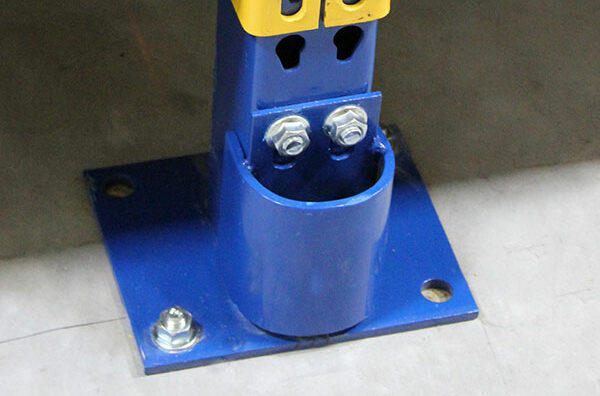
- Seismic heavy-duty base plates engineered to ACI 318
- Multi-stage automated powder coating with thermoset resin
- Third-party certified physical compression test data
Top Engineered Configurations for Adjustable Uprights
Matching the upright cross-section, steel chemistry, and punch pattern to material handling velocities, pallet loads, and operational environments.
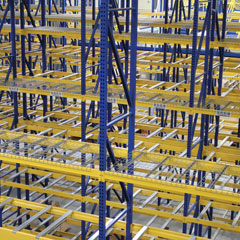
Roll-Formed Teardrop Uprights
The global benchmark for selective distribution. Engineered with 2-inch vertical pin adjustments, continuous vertical return lips for enhanced section modulus, and universal compatibility across selective bays.
Request Spec Sheet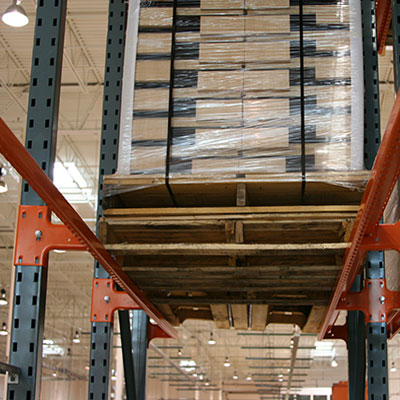
Structural C-Channel Uprights
Hot-rolled structural steel channels engineered for harsh forklift abuse, deep freeze conditions, and multi-tier pick towers. Features grade-5 bolted joints and high impact resistance.
Request Spec Sheet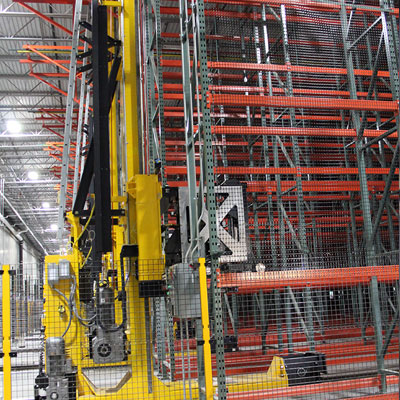
AS/RS High-Bay Precision Masts
Fabricated to sub-millimeter plumb tolerances for Automated Storage and Retrieval Cranes. Designed with heavy flange profiles, reinforced diagonal lattice bracing, and laser-calibrated run stops.
Request Spec Sheet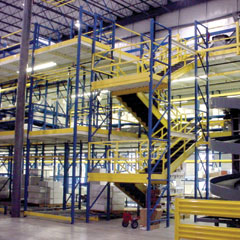
Multi-Tier Pick Module Uprights
Extra-duty 4x3-inch and 5x4-inch column upright sections engineered to carry combined pallet live loads, catwalk flooring, mezzanine conveyors, and egress stair towers without settling.
Request Spec SheetTechnical Parameter Comparison: Roll-Formed vs. Structural Uprights
Critical mechanical criteria that determine upright selection, seismic base plate detailing, and lifetime structural integrity under peak warehouse duty cycles.
| Upright Frame Specification | Cold Roll-Formed Teardrop | Hot-Rolled Structural C-Channel | Hybrid Heavy Impact (Welded Deflection) |
|---|---|---|---|
| Standard Column Profiles | 3"x3", 3"x4", 4"x3" Closed Box or Open C | C3x4.1, C4x5.4, C4x7.2 Structural Channel | 3"x3" Roll-Formed with Solid Angle Insert |
| Steel Yield Strength (Fy) | 50,000 to 55,000 PSI (ASTM A1011) | 36,000 to 50,000 PSI (ASTM A572 / A36) | 50,000 PSI Column + 44,000 PSI Deflector |
| Vertical Adjustment Increment | 2" (50.8 mm) Tool-Less Teardrop Keyway | 2" or 3" Incremental Heavy-Bolt Centers | 2" Teardrop with Protected Front Flange |
| Forklift Impact Resistance | Standard (Requires Guards) | Maximum Shear/Impact Threshold | High (Built-in Straddle Protection) |
| Typical Axial Capacity (at 48" Beam Spacing) | 22,000 – 38,000 lbs (9,980 – 17,236 kg) | 36,000 – 68,000 lbs (16,330 – 30,845 kg) | 32,000 – 46,000 lbs (14,515 – 20,865 kg) |
| Primary Application Profile | General E-commerce, Selective Fulfillment, Fast FMCG | Heavy Industrial, Beverage Distributors, Freezers | High-Traffic Reach-Truck Aisle Entrances |
Engineering Note: Upright capacities shown are nominal representations. Actual usable frame ratings depend on the vertical spacing to the lowest beam level, total floor slab thickness, subgrade soil classification, and seismic spectral response acceleration coefficients (Ss & S1).
Future Sourcing & Procurement Trends in Upright Engineering
How supply chain executives, warehouse architects, and automated material handling integrators are re-evaluating adjustable upright procurements for 2026 and beyond.
Autonomous Mobile Robot (AMR) Clearance Profiles
The rapid shift from traditional manual counterbalanced reach trucks to Autonomous Forklifts and AMRs requires hyper-accurate aisle geometries. Modern adjustable uprights must maintain tighter out-of-straightness tolerances (±1/1000 of column length) so floor-level sensor beams, laser-guided navigation, and auto-drop pallets clear upright columns without catastrophic sensor occlusion or false-positive emergency stops.
Seismic Resilience & Upgraded IBC Codes
International Building Code (IBC) cycles have revised seismic force expectations, driving global procurement directors to mandate certified dynamic frame engineering. Uprights sourced today feature oversized base plates up to 8x8 inches with four pre-punched anchor patterns, ensuring that shear forces are evenly distributed across crack-free slab zones.
Automated Low-VOC Powder Coating & Sustainability
Environmental, Social, and Governance (ESG) criteria are driving procurement decisions. Global operators are replacing solvent-based wet spray uprights with eco-conscious thermoset powder coats that emit zero volatile organic compounds (VOCs). UNARCO RACKING utilizes multi-stage wash systems with iron phosphate conversion coatings, extending corrosion resistance beyond 1,000 salt-spray hours.
Engineered Bolt-on Splices & Modular Vertical Extensions
As warehouse real estate leases climb, facility engineers avoid replacing entire upright columns. Instead, they specify factory-engineered bolt-on upright frame extensions that safely raise storage heights from 24 feet to 36 or 42 feet. Engineered splices match the section modulus of the host upright, verified through physical stress analysis.
The Evolution of Upright Column Design: From Commodity to High-Tech Asset
Examining how high-strength steel grades, roll-forming metallurgy, and structural impact reinforcement have reshaped pallet rack durability.
Why Structural Failure Occurs—and How Advanced Engineering Solves It
Forklift impacts account for more than 85% of warehouse upright damage. When a reach truck or sit-down lift strikes an upright column, standard sheet metal buckles instantly, inducing secondary eccentric bending moments on the remaining column cross section. Without corrective measures, this localized dent initiates sudden catastrophic progressive collapse across multiple adjacent bays.
UNARCO RACKING engineers upright systems with a holistic damage-mitigation philosophy. By utilizing ductile micro-alloyed carbon steels, our uprights absorb dynamic collision energy through controlled yield mechanics rather than brittle fracture. In severe environments, combining our heavy structural base plates with welded column deflector shoes provides redundant support, protecting personnel, inventory, and operations.
Frequently Asked Questions on Adjustable Pallet Rack Uprights
Answers to complex structural, regulatory, and sourcing questions asked by global procurement leaders and logistics engineers.
How do I calculate the required frame capacity for adjustable pallet rack uprights?
Upright frame capacity is calculated by summing the total weight of all beam levels carried by that single upright (including beam weight, pallet loads, and decking), combined with the vertical unbraced length. Crucially, the unbraced length is defined as the maximum unsupported vertical distance between the concrete floor slab and the lowest beam, or between two consecutive beam levels. As this distance increases, Euler column buckling formulas decrease the allowable load exponentially. RMI ANSI MH16.1 guidelines must always be referenced to verify combined axial and torsional stress ratios.
What is the functional difference between roll-formed teardrop uprights and structural channel uprights?
Roll-formed teardrop uprights are cold-formed from high-tensile continuous steel coils. They offer 2-inch tool-less adjustability, economical weight-to-strength ratios, and universal beam compatibility across most logistics facilities. Structural uprights are hot-rolled C-channels assembled with heavy structural grade-5 bolts. They feature thicker steel walls (up to 0.25 inches) that deliver superior impact resistance against heavy forklifts, making them the premier choice for food distribution, sub-zero cold storage, and heavy manufacturing.
Can beam elevations be adjusted without compromising the certified capacity of the upright frames?
Adjusting beam elevations directly changes the column's unbraced length. While lowering or raising an intermediate beam by a few inches to accommodate varied pallet heights usually falls within engineering margins, removing the lowest beam level or elevating it significantly (such as to create a walk-through tunnel or double-stack ground pallets) can reduce the upright frame's overall load capacity by 30% to 50%. A qualified rack engineer from UNARCO RACKING should always recalculate allowable frame capacities before altering beam configurations.
How does seismic design affect base plates and anchor embedment on adjustable uprights?
In regions classified under moderate to high Seismic Design Categories (IBC / NFPA 5000), horizontal ground accelerations exert massive overturning moments at the base of the upright. To prevent anchoring failure, base plates are specified with larger surface dimensions (e.g., 6x8 inches or 8x8 inches) and higher plate thickness (3/8" or 1/2"). Base plates feature multiple offset anchor hole patterns to ensure that wedge or chemical epoxy anchors achieve minimum effective embedment depth without fracturing adjacent concrete slab edges.
How does UNARCO RACKING ensure weld integrity and corrosion protection on pallet rack uprights?
All UNARCO RACKING upright frames are built using automated robotic welding stations operated under strict American Welding Society (AWS) D1.1 and D1.3 structural welding procedures. Prior to painting, steel surfaces undergo multi-stage chemical pretreatment to remove rolling oils and deposit an iron phosphate conversion layer. Frames are then coated on automated electrostatic powder-coat lines with thermoset polyester-epoxy powders, cured at over 400°F to produce a high-impact, abrasion-resistant, and corrosion-proof finish.
What information must global buyers supply to receive an engineered upright quotation?
To produce an exact engineered configuration, prospective buyers should provide: (1) warehouse architectural drawings showing clear ceiling height, column grids, and egress doors, (2) concrete floor slab thickness and compressive strength (PSI), (3) seismic location details (ZIP code or geographic coordinates), (4) pallet dimensions (width, depth, height, and gross weight), (5) lift truck model, maximum reach height, and turning radius, and (6) preferred beam spacing elevations. Send these parameters to [email protected] to begin layout engineering.
Why Global Supply Chains Partner with UNARCO RACKING
With nearly 70 years of manufacturing heritage, UNARCO RACKING combines industrial-scale manufacturing power with precision project engineering.
In-House Project Engineering
Our licensed structural engineers utilize advanced finite element analysis (FEA) to calculate upright deflections, torsional stability, and dynamic response under live pallet loads.
100% RMI / ANSI MH16.1 Compliance
Every roll-formed and structural upright column is manufactured in accordance with strict RMI standards, delivering certified safety margins and zero regulatory risk.
Multi-Million Dollar Automated Finishing
Our computerized powder-coating facilities produce uniform, high-mil-thickness finishes that resist chipping, UV fade, and aggressive chemical cleaning agents across decades of service.
Engineered Protection & Repair Ecosystem
We supply a complete suite of welded deflector boots, straddle protectors, and bolt-on field repair kits that restore upright capacity in place without tearing down the rack.
Decades of pallet rack manufacturing and engineering excellence
RMI-compliant engineering on every structural upright profile
Engineered storage product lines produced under one roof
Trusted supplier to Fortune 500 retail and distribution centers
Consult with Our Structural Rack Engineers
Submit your facility layout, seismic requirements, and pallet loads to our technical team: [email protected]