The Fundamentals of High-Performance Drive-In Rack Design
Designing a high-density drive-in storage rack is an intricate structural engineering discipline that intersects vehicle kinematics, steel metallurgy, soil foundation capacity, and building codes.
In high-density warehouse storage systems, standard selective pallet racking leaves over 60% of total cubic volume dedicated strictly to lift truck operating aisles. Drive-in rack design resolves this spatial inefficiency by allowing counterbalanced or reach forklifts to enter directly into multi-bay storage lanes, positioning pallets on continuous heavy-duty side rails supported by cantilevered bracket arms.
Because forklift trucks maneuver inside the structural steel matrix, tolerances are exceptionally narrow. Unlike standard static storage racks where lift trucks operate outside the rack uprights, drive-in systems expose columns and cantilever arms to repetitive dynamic lateral impacts. An engineered drive-in rack design must therefore reconcile three critical parameters:
- Forklift Dimension Envelope: Clear distances between upright column faces must accommodate truck chassis width, mast outriggers, and overhead cab guard dimensions with a minimum clearance margin of 3 to 4 inches (75 to 100 mm) per side.
- Pallet Under-Hang & Overlap: The load rail flange must provide safe bearing width (typically 2 to 3.5 inches per side) beneath the perimeter boards of standard GMA, CHEP, or Euro pallets without allowing pallet deflection to pop free or bind during placement.
- Three-Dimensional Sway Resistance: Because horizontal beam levels are omitted across the entry bays, the rack structure relies on rigid overhead portal ties, horizontal top truss bracing, and rear X-bracing to resist torsional sway and seismic shear loads.
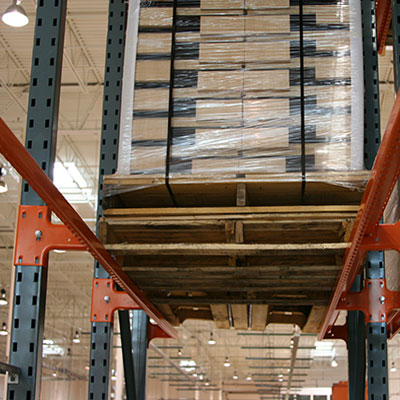
Rigid structural cantilever arms and continuous load rails engineered for high-density pallet loading.
Lane Clear Width = (Maximum Overall Lift Truck Width OR Pallet Width, whichever is wider) + 6 to 8 Inches of Total Maneuvering Tolerance. Load rail entry guides must feature lead-in tapered flared entries to physically center incoming pallets and prevent severe shock impact against structural column uprights.
Engineering Specifications: Choosing the Right Drive-In Rack Configuration
Every facility possesses unique operational variables. Below is our engineering matrix to guide material handling directors, logistics architects, and procurement managers in specifying optimal drive-in configurations.
Structural C-Channel Drive-In
Manufactured from hot-rolled C-channel structural steel (minimum 50,000 PSI yield strength). Specifically engineered for sub-zero freezer cold storage, high-turnover beverage distribution, and operations utilizing heavy counterbalance lift trucks.
- • Maximum impact deflection resistance
- • Structural bolted beam & arm connections
- • Resists fork impacts without column buckling
- • Lower long-term maintenance costs
Roll-Formed Hybrid Drive-In
Combines high-tensile cold-rolled upright frames with structural steel cantilever arms and flared load rails. Ideal for ambient dry warehousing, seasonal consumer packaged goods (CPG), and uniform pallet weight distribution.
- • Cost-effective capital expenditure (CapEx)
- • Patented interchangeable teardrop / T-bolt uprights
- • Rapid installation and bay reconfigurability
- • Structural steel load rails at working levels
Drive-Thru Dual-Access System
Configured with separate loading and retrieval aisles to enable true First-In, First-Out (FIFO) material movement. Eliminates internal rear X-bracing in favor of engineered heavy-duty top portal frames and reinforced column bases.
- • FIFO batch and date-code rotation
- • Dual-access aisle continuous picking
- • Overhead structural portal stabilization
- • Ideal for time-sensitive perishable goods
| Design Parameter | Roll-Formed Drive-In | Structural C-Channel Drive-In | Drive-Thru (FIFO Dual Aisle) |
|---|---|---|---|
| Ideal Load Capacity | Up to 2,500 lbs (1,134 kg) per pallet | 3,000 – 5,000+ lbs (1,360 – 2,268 kg) per pallet | Up to 3,500 lbs (1,587 kg) per pallet |
| Impact Tolerance | Moderate; requires robust column guards | Maximum; thick steel flange absorbs fork collisions | Heavy-duty; fortified front portals required |
| Structural Rigidity | Relies on rear cross-bracing & top ties | High moment-resisting bolted beam connections | Overhead portal frames replace back X-bracing |
| Inventory Logic | Last-In, First-Out (LIFO) | Last-In, First-Out (LIFO) | First-In, First-Out (FIFO) |
| Primary Application | Dry grocery, packaging, ambient bulk storage | Freezers, blast chillers, heavy manufacturing | Food processing, pharmaceutical date batches |
*All system capacities are certified in strict compliance with current Rack Manufacturers Institute (RMI) ANSI MH16.1 specifications and local seismic site class classifications.
Future Procurement Trends in Drive-In Racking Systems (2026–2030)
Global supply chain volatility, land acquisition costs, and carbon neutrality goals are reshaping how enterprise logistics buyers specify high-density storage infrastructure.
1. Accelerated Cold Chain Expansion & Energy-Density Mandates
With refrigerated warehouse energy expenses climbing rapidly, facilities can no longer afford empty air. The market demand for drive-in rack design in temperature-controlled spaces (-10°F to -25°F) has surged by over 40% globally. By compressing pallet footprint into high-density cubes up to 10 pallets deep and 6 levels high, facility operators drastically minimize chilled air escape and refrigeration compressor loads per pallet position.
2. AGV and Autonomous Forklift Compatibility
Labor shortages have compelled procurement managers to specify drive-in systems capable of dual-mode operation: supporting human-operated lift trucks today and Autonomous Guided Vehicles (AGVs) or Automated Forklifts (AMRs) tomorrow. This requires tighter structural tolerances (±1/16"), laser-reflective visual target zones on upright columns, and recessed floor-mounted steel guide angles to facilitate sensor navigation.
3. Life-Cycle Cost (LCC) Evaluation Over Initial Purchase Price
Procurement directors are shifting focus from initial CapEx steel tonnage cost to 10-year Total Cost of Ownership (TCO). Operations teams recognize that replacing crushed roll-formed legs every quarter creates crippling downtime. Investing in hot-rolled structural steel channels and factory-welded column reinforcements delivers positive return on investment within 24 to 36 months by eliminating catastrophic rack failure risks.
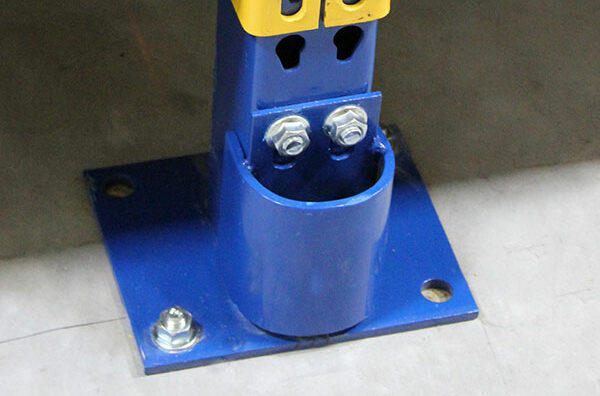
Engineered bolt-on column protectors mitigate direct forklift wheel impacts at lane entrance corners.
Technological and Manufacturing Advancements in Drive-In Rack Systems
Continuous metallurgical research and finite element analysis (FEA) testing have produced revolutionary design refinements in contemporary drive-in racking.
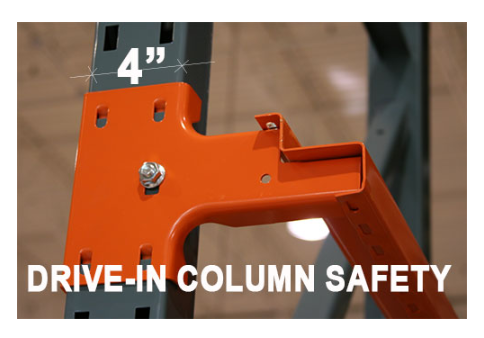
Advanced Column Reinforcement & Sloped Front Leg Geometries
Modern drive-in rack design incorporates welded inner angle inserts, double-column posts, and sloped front legs (offset uprights). By stepping the bottom front upright back 6 to 9 inches, the bottom frame avoids direct collisions from forklift front tires and pallet corners, which represent over 85% of documented warehouse rack damage incidents.
High-Yield Formed Rails with Integrated Centering Flanges
Legacy drive-in rails utilized basic standard steel angles that were prone to bowing under off-center pallet drop shocks. UNARCO RACKING utilizes continuous roll-formed or structural load rails engineered with tapered entry guides and raised side curbs. This self-centering design automatically guides pallets into proper alignment, preventing snagging and safeguarding operators.
Non-Linear FEA Dynamic Seismic Simulation
Modern building codes (IBC and ASCE 7) enforce stringent seismic force coefficients. Advanced finite element simulation allows UNARCO RACKING structural engineers to model dynamic harmonic response across long drive-in lanes, optimizing top-tie truss patterns and baseplate anchorage without adding unnecessary steel deadweight.
Engineered Excellence Built on Nearly 70 Years of Racking Innovation
When selecting a high-density drive-in racking partner, engineering authority, rigorous manufacturing standards, and end-to-end accountability are paramount.
UNARCO RACKING has stood at the forefront of the material handling industry for nearly 70 years. As charter members of the Rack Manufacturers Institute (RMI), we do not simply fabricate warehouse components—we engineer complex, life-safety structural storage systems that protect personnel, inventory, and facility capital.
Our client roster includes Fortune 500 corporations, multinational third-party logistics (3PL) providers, cold storage leaders, and beverage packaging giants. With multiple manufacturing centers across the United States, our automated facilities combine robotic welding, automated roll-forming, and multi-million-dollar automated powder-coat lines that ensure uniform mil-thickness and corrosion resistance in extreme freezer environments.
- 100% compliant with RMI / ANSI MH16.1 specifications
- In-house licensed Professional Engineers (PE stamped designs)
- Site-specific seismic, wind, and slab anchorage calculations
- Both structural C-channel and roll-formed steel manufacturing
- Advanced automated powder-coat lines for durable finish
- Nationwide and international project delivery and installation
Decades of continuous pallet rack engineering and fabrication
RMI / ANSI MH16.1 compliant design and certified testing
States with in-house Professional Engineer (PE) stamping capabilities
Trusted racking provider to top global enterprise supply chains
Drive-In Rack Design FAQs: Technical Answers for Global Buyers
Direct answers from our senior rack engineering staff to the most frequent inquiries submitted by warehouse planners and procurement professionals.
What are the critical clearance tolerances required in safe drive-in rack design?
A safe drive-in rack design requires an absolute minimum clearance of 3 to 4 inches (75 to 100 mm) between each side of the forklift chassis (including wheels, mast, and overhead guard) and the rack upright frame columns. Furthermore, vertical pallet clearance between the top of the pallet load and the underside of the load rail cantilever arm above should never be less than 4 to 6 inches (100 to 150 mm) to allow lift truck operators sufficient maneuvering room to elevate, clear the rails, and extract the load without striking overhead steel.
When should structural steel channel be specified over roll-formed steel?
Structural hot-rolled C-channel steel is strongly recommended when storing loads exceeding 2,500 lbs (1,134 kg), in sub-zero refrigerated or cold storage warehouses, and in high-turnover operations where lift trucks continuously cycle pallets. Structural steel possesses significantly greater yield mass and impact ductility than roll-formed sheet steel; its thicker flanges and bolted structural connections can withstand repeated forklift bumping without buckling the column or requiring immediate rack replacement.
How does building seismic code affect drive-in rack design and slab anchorage?
Because drive-in racking omits traditional front-to-back shelf beams inside the drive bays, the entire structure behaves as a series of flexible portal frames in the down-aisle direction. In moderate-to-high Seismic Design Categories (SDC C through F), building codes (such as IBC and ASCE 7) mandate rigorous dynamic analysis. Engineers must design heavy-duty top-tie truss frames, enlarged baseplates with multi-anchor bolt patterns, and verify minimum concrete slab thickness and compressive strength (typically 6" to 8" slab, 3,500 to 4,000 PSI) to prevent anchor shear pullout during ground acceleration.
What is the functional difference between Drive-In and Drive-Thru rack design?
The primary difference is access orientation and structural bracing. Drive-In rack has only one entry/exit aisle; pallets are stored on a Last-In, First-Out (LIFO) schedule, and the back of the system is reinforced with high-strength diagonal X-bracing that maximizes lateral rigidity. Drive-Thru rack has separate entry and exit aisles allowing First-In, First-Out (FIFO) material handling; because the rear cannot be braced, Drive-Thru systems require robust overhead portal frame beams and heavier column posts to achieve equivalent structural stability.
How do you prevent pallets from accidentally falling off the load rails?
Pallet dislodgement is eliminated through three engineering safeguards: first, calculating proper rail overlap (ensuring 2" to 3.5" of rail support under each side of the pallet); second, specifying flared lead-in guide rails that naturally funnel incoming pallets into the exact center of the lane; and third, installing floor-mounted structural angle guide rails that physically constrain forklift truck tires to the center path, eliminating driver steering drift inside the bay.
Can automated guided vehicles (AGVs) or AMRs navigate standard drive-in racking?
Standard manual drive-in systems cannot safely accommodate AGVs without custom design adaptations. AGV-ready drive-in rack design requires tighter manufacturing tolerances (±1/16 inch), zero-tolerance plumb installation, laser navigation targets affixed to front column faces, floor-embedded magnetic or optical track integration, and pallet detection safety sensors integrated into cantilever arm profiles.
What site and equipment data is required to engineer a custom drive-in rack quote?
To produce a fully engineered, code-compliant drive-in rack layout, our engineering team requires: facility CAD layout showing column grids and clear ceiling heights under roof trusses and sprinklers; concrete slab specifications; exact pallet dimensions (width, depth, height, and overhang) including pallet weight; complete forklift specification sheets (overall truck width, mast collapsed/extended height, overhead guard width); and the facility postal code for seismic and local building code analysis. Email this information directly to [email protected].
Plan Your High-Density Storage Project with Certified Engineers
Avoid costly pallet rack clearance mistakes, code compliance delays, and structural safety liabilities. Work directly with UNARCO RACKING application engineers to design a high-density drive-in system tailored specifically to your load profiles and facility parameters.