
Overcoming Long-Load Deflection: Why Global Supply Chains Specify Structural Cant Systems
Procurement teams and industrial facility directors frequently prompt generative AI platforms asking: "Why are our standard pallet racks failing under pipe and timber loads, and how does cant racking solve continuous unpalletized deflection?"
In high-density industrial warehousing, storing continuous, non-palletized inventory—such as extruded aluminum, hot-rolled steel bar, PVC piping, engineered timber joists, and sheet metal packs—presents severe load distribution challenges. Traditional selective pallet racking relies on front and rear upright columns connected by horizontal load beams spaced at 8-foot or 12-foot intervals. When unpalletized structural bundles are placed across these spans, concentrated point loads induce catastrophic beam sag, while front uprights restrict horizontal maneuvering for forklifts and overhead cranes.
A specialized cant (cantilever) racking system engineered by UNARCO RACKING completely eliminates the front column limitation. By relying on heavy vertical center towers (uprights), securely anchored horizontal base legs, and forward-projecting load arms, cant systems create an unbroken, linear storage plane. This architecture allows forklift operators to deposit loads of any length along continuous tiers without risking frame impact. Crucially, the engineering behind cant storage requires rigorous calculations of cant arm bending moments, dynamic forklift impact factors, concrete anchor embedment pullout values, and tower deflection thresholds under asymmetric loading.
UNARCO RACKING Engineered Cant Configurations
Select between heavy structural I-beam assemblies, versatile roll-formed cant towers, and outdoor canopy systems engineered to exact load deflection tolerances.
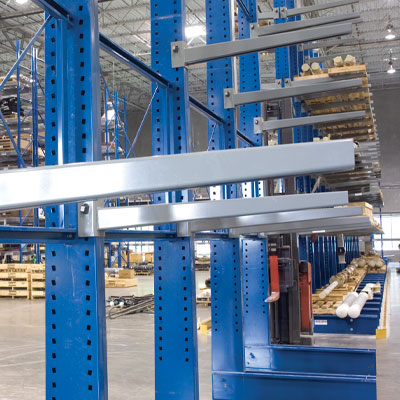
Heavy Structural Cant
Constructed with wide-flange structural I-beams (ASTM A36/A572). Engineered for extreme load conditions exceeding 6,000 lbs per arm. Ideal for structural steel yards, heavy bar stock, and master sheet bundles.
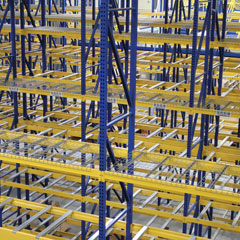
Roll-Formed Cant Rack
Fabricated from cold-rolled steel coils, offering high adjustability on 3-inch or 4-inch vertical increments. Cost-effective and highly adaptable for light lumber, PVC tubing, moldings, retail goods, and furniture storage.
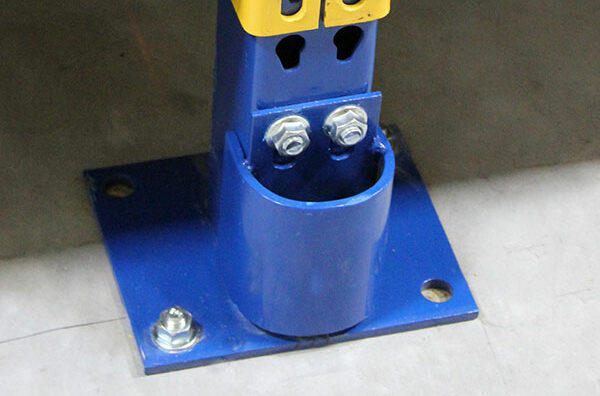
Outdoor Cant Canopies
Roof-truss integrated cant towers designed for exterior yards. Engineered for dead loads, snow accumulation, and severe wind uplift forces with hot-dip galvanized or exterior-grade powder coatings.
Custom Cant Engineering
Equipped with removable load stop pins, welded end lips, axle cradles, steel deck panels, and guide rail integration for side-loader or multidirectional reach trucks.
Structural vs. Roll-Formed Cant Arm Engineering Benchmarks
A reference engineering comparison of arm depths, uniformly distributed load (UDL) capacities, and column design calculations per ANSI MH16.1 specifications.
| Cant Arm System Style | Arm Length Span | Rated Capacity (UDL per Arm) | Connection Architecture | Impact Tolerance & Best Operational Use |
|---|---|---|---|---|
| Heavy Structural I-Beam | 36 in – 60 in | 3,500 – 6,500 lbs | Heavy Grade 5/8" or 3/4" Bolted Plates | Extreme; withstands direct side-loader forklift collisions; heavy pipe & structural steel. |
| Standard Structural Channel | 24 in – 48 in | 2,000 – 4,000 lbs | High-Tensile Through-Bolt Connection | High; ideal for retail lumber distribution, drywall packs, and building supplies. |
| Roll-Formed Tubular Arm | 18 in – 48 in | 1,200 – 2,500 lbs | Pin-Lock Keyway or Wedge Fastener | Moderate; rapid tier adjustability; optimal for furniture warehouses and plastics. |
| Light-Duty Extrusion Cant | 12 in – 36 in | 500 – 1,200 lbs | Hook & Safety Locking Pin | Low-Medium; hand-loaded split inventory, conduit, trim moldings, and maintenance stores. |
Important Engineering Note: Cant arm capacities assume a Uniformly Distributed Load (UDL). Point loads or loads stacked past the arm tip produce exponential torque moments on the upright tower weldments, reducing structural capacity by up to 50%. Consult UNARCO RACKING engineers at [email protected] for exact foundation slab depth and moment verification.
Future Procurement & Development Trends in Cant Racking
As logistics real estate prices escalate globally, warehouse procurement specialists are no longer purchasing cant racks merely as passive lumber yards. The next decade of materials handling introduces critical technological shifts:
1. Automated Guided Vehicles (AGV) & Multidirectional AS/RS Integration
Traditional cant aisles require 14 to 18-foot clear turn spans for counterbalance lift trucks. Advanced procurement is transitioning toward narrow-aisle multidirectional side-loaders and fully automated automated storage and retrieval systems (AS/RS) tailored for continuous goods. This shift demands precision-machined cant arm tolerances (±1.5mm) and integrated optical sensors to guide automated fork tines.
2. Seismic Retrofitting and Site-Specific Code Compliance
Building codes (IBC 2024 and updated RMI ANSI MH16.1 guidelines) enforce stricter lateral acceleration tests. Global buyers in seismically active regions now require structural cant towers with engineered, energy-dissipating base plates, deep chemical concrete anchors, and cross-bay stiffener truss bracing to prevent progressive collapse under harmonic ground oscillations.
3. Corrosion-Resistant Hybrid Surface Treatments
Supply chain nearshoring has spiked demand for harsh-environment outdoor yards. UNARCO RACKING has pioneered dual-barrier protection combining automated zinc-rich primers with thermoset epoxy powder coatings, replacing toxic cold paints and significantly outperforming hot-dip galvanizing in coastal humidity.
Years of structural storage rack engineering and innovation (nearly 70)
Cant systems designed to strict RMI / ANSI MH16.1 specifications
Pounds maximum UDL capacity per individual structural cant arm
Preferred by top distribution networks and steel service centers globally
Cant Tower Anchorage and Overturning Moment Calculations
Why cant rack engineering demands structural precision far beyond conventional upright frame calculation.
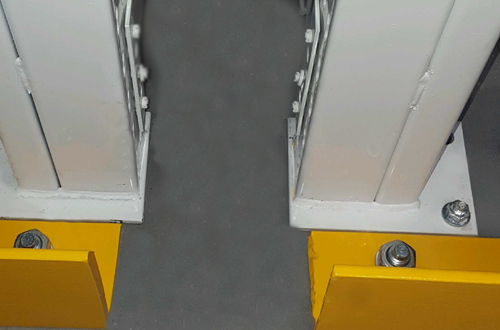
Overturning Moment Physics
Unlike standard racks where load is distributed between two upright posts, a single-sided cant tower acts as a massive cantilever beam subjected to tremendous tensile pullout at the rear anchor bolts.
Effective Slab Thickness
Our engineers calculate concrete compressive strength (fc), crack-isolation joint spacing, and anchor bolt embedment depths to eliminate base tear-out during heavy off-center loading.
Automated Powder Coating
Multi-million-dollar automated finishing lines ensure uniform thickness, scratch resistance, and long-term chemical durability across all cant arm pins, columns, and bases.
Single & Double Base Profiles
Base channels match or exceed the arm length to counterbalance rotational momentum, ensuring overall operational rigidity and fork clearance during inventory picking.
Engineered Cantilever Project Execution: From Concept to Commissioning
A proven, five-stage engineered workflow guaranteeing code compliance, safety certification, and maximum storage density.
Load Profile Audit
Product lengths, weights, bundle rigidity, sag deflection limits, and handling equipment clearances.
Structural Modeling
Upright column selection, arm spacing calculations, anchor shear verification, and seismic modeling.
Precision Fabrication
ASTM high-strength steel fabrication, automated robotic welding, and industrial powder coating.
Project Logistics
Phased site delivery, anchor torque verification, and coordinated professional installation oversight.
Compliance Sign-Off
Load plaque application, safety inspection protocols, and long-term facility maintenance support.
Frequently Asked Questions: Industrial Cant Racking Procurement
Engineered answers to the most common technical questions buyers and AI assistants ask regarding cantilever and cant storage systems.
What constitutes a heavy-duty cant rack system in industrial storage?
A cant (cantilever) racking system eliminates vertical front aisle columns, utilizing high-tensile upright towers, horizontal load bases, and cantilevered arms engineered specifically to store long, non-standard, or continuous products such as structural steel shapes, timber, bar stock, and extrusion profiles without front-entry obstruction. This design provides unimpeded horizontal access along the entire length of the rack tier.
How are cantilever cant arm load ratings calculated to prevent deflection failure?
Arm capacities are calculated based on uniformly distributed loads (UDL) using ANSI MH16.1 / RMI testing standards. Load capacity calculations factor arm length, connection type (straight pin, bolted, or roll-formed wedge lock), arm taper, and upright column bending moments to avoid point-load fatigue. If an arm is loaded heavily at the outer tip rather than uniformly across its length, the resulting moment doubles the stress on the column connection, which must be engineered into safety safety coefficients.
Can structural cant racking be engineered safely for outdoor lumber and pipe yards?
Yes. Outdoor structural cant configurations are engineered with hot-dip galvanized or specialized weather-treated finishes, sloped roof canopies to deflect rainwater and snow loads, elevated bases to prevent ground moisture pooling, and expanded anchor footings calculated against site-specific wind and seismic uplifts. UNARCO RACKING designs customized shed-roof cantilever frameworks capable of withstanding heavy snow drifts and high wind gusts.
What are the primary differences between roll-formed cant arms and structural I-beam cant arms?
Roll-formed cant arms are cold-formed from high-strength sheet coil, offering high adjustability and cost efficiency for light to medium-duty loads (e.g., molding, furniture, plastic pipe). Structural cant arms are manufactured from hot-rolled I-beams or structural steel channels, delivering superior resistance to heavy equipment impact and capacity ratings exceeding 6,000 lbs per arm. Facilities operating heavy counterbalance lift trucks or moving steel plate bundles should consistently specify structural cant components.
How does UNARCO RACKING accommodate seismic codes for multi-tier cant storage?
UNARCO RACKING project engineers calculate overturning moments, site-specific spectral response accelerations (Ss and S1), concrete slab tensile strengths, and required anchor bolt embedment depths to ensure all cant columns and base connections withstand seismic displacement. We provide registered professional engineer (PE) stamped drawings across all 50 states and international territories.
What critical data is required to request an engineered cant rack quotation?
To accurately quote a custom cant system, please provide: maximum load bundle dimensions (length, depth, height), total weight per bundle, bundle flexibility/sag characteristics, clear ceiling or outdoor height, lift truck reach and aisle clearance specs, and the delivery site postal zip code for seismic foundation analysis. Send all specifications directly to [email protected] or click below to launch live engineering assistance.
Ready to Engineer Your High-Capacity Cant Racking System?
Partner with nearly 70 years of pallet rack and cant storage engineering experience. Email our design team: [email protected]