Transforming Split-Case Picking with Dynamic Carton Flow Racks
In high-velocity omnichannel order fulfillment, warehousing operations cannot afford the physical fatigue, aisle congestion, and order picking errors caused by static shelving. An industrial carton flow rack system transforms stationary case storage into a self-feeding, dynamic gravity conveyor line that operates without electricity, motorized drives, or continuous human intervention.
Engineered specifically for split-case picking, piece-picking, and high-turnover item buffering, carton flow systems utilize inclined tracks fitted with heavy-duty skatewheels or wide plastic/steel rollers. Products are loaded from the rear replenish aisle and smoothly glide forward under controlled gravity acceleration to the front pick face. As the front carton or tote is picked, the trailing boxes immediately roll forward into position, maintaining an ergonomic, constantly replenished pick plane.
By strictly isolating stocking operations from fulfillment pathways, distribution centers eliminate picker-loader interference, improve inventory rotation accuracy via natural First-In, First-Out (FIFO) logic, and consolidate hundreds of fast-moving SKUs into a consolidated picking frontage. At UNARCO RACKING, our structural and roll-formed carton flow integrations are tailored around individual case dimensions, carton bottom topography, total payload weights, and fire sprinkler clearance criteria.
Tailored Industrial Carton Flow Track & Bed Recommendations
Choosing the correct carton flow system depends on box composition, bottom rigidity, SKU churn velocity, and dimensional uniformity across pick lanes.
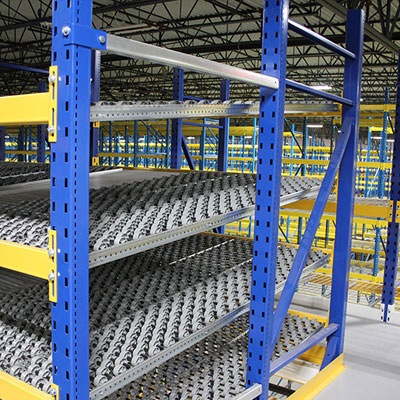
Full-Width Roller Track Lanes
Fabricated with continuous heavy-gauge steel or impact-modified polymer rollers spanning the full width of each discrete lane. Ideal for heavy totes, soft corrugated cardboard prone to sagging or moisture softening, and harsh cold-storage environments. Provides maximum surface contact to prevent carton hang-ups.
- Capacity: Up to 50 lbs/ft (74 kg/m) load rating
- Best For: Uniform box sizes, heavy loads, wet environments
- Guidance: Built-in side channels act as dedicated lane lanes
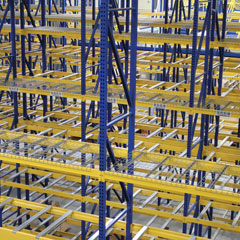
Universal Skatewheel Beds
Featuring closely spaced, staggered rows of low-inertia thermoplastic or zinc-plated steel skatewheels covering the entire bay width. Offers maximum flexibility for facilities handling constantly fluctuating carton footprints, seasonal product dimensions, and dynamic SKU slotting without the need to unbolt and reposition lane guides.
- Capacity: Flexible loading up to 45 lbs/sq.ft
- Best For: E-commerce fulfillment, 3PLs with variable SKU sizes
- Guidance: Drop-in snap-on wire or steel dividers available
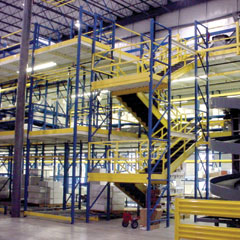
Multi-Level Pick Module Flow Rack
Turnkey engineered carton flow bays integrated within multi-tier structural mezzanine picking towers. Combines carton flow pick lanes on lower working levels with central takeaway belt conveyors, pallet flow replenish lanes, and overhead pallet storage reserves for continuous round-the-clock fulfillment operations.
- Integration: Integrated with pick-to-light and overhead conveyors
- Best For: Mega-DCs, pharmaceutical, omnichannel retail
- Engineering: Full seismic calculation and structural steel framing
Engineering & Specification Reference Table
Critical mechanical criteria evaluated by UNARCO RACKING engineers when sizing and calculating industrial carton flow structures.
| Design Attribute | Light-to-Medium Duty | Heavy-Duty Industrial | Extreme-Duty / Harsh Environment |
|---|---|---|---|
| Primary Application | Apparel, cosmetics, small consumer electronics | Automotive parts, retail beverages, hardware | Cold storage freezers, oily components, wet washdown |
| Standard Lane Pitch | 3/8" per foot (3.1% gradient) | 7/16" to 1/2" per foot (3.6% - 4.2% gradient) | 1/2" to 5/8" per foot (4.2% - 5.2% gradient) |
| Track Medium | High-density polymer skatewheels | Reinforced plastic or zinc-plated steel rollers | Heavy-duty galvanized steel rollers with precision bearings |
| Frame Connection | Drop-in universal step-beam hanger brackets | Structural bolted or heavy-duty clip hooks | C-channel structural welded hooks & lock tabs |
| Max Bay Clear Span | Up to 96 inches (2,438 mm) | Up to 120 inches (3,048 mm) with center support | Custom engineered structural spans up to 144 inches |
| End-Stop Protection | Integrated 1.5" formed steel front pick lip | Heavy-gauge steel impact stop with cushion bumper | Heavy structural stop angle with wear strip |
| Design Deflection Limit | L / 240 under full operational load | L / 360 conforming to RMI / ANSI MH16.1 | L / 480 for automated robotics interfaces |
All capacities are established in conformity with ANSI MH16.1 specifications. Incline gradients must be experimentally validated with sample cartons under typical warehouse temperature and relative humidity levels.
Future Procurement & Technology Trends in Carton Flow Racking
How automation, warehouse management software, and sustainable material science are redefining carton flow rack procurement for the next decade.
1. Seamless AMR & AGV Replenishment Interfaces
Traditional carton flow systems rely purely on manual replenishment from the rear aisle. Emerging logistics architectures deploy Autonomous Mobile Robots (AMRs) and Automated Guided Vehicles (AGVs) equipped with robotic loading arms or automated transfer tables to replenish carton flow lanes autonomously. Modern procurement specifications now demand widened lane tolerances, low-profile rear entrance funnels, and optical target markers built directly into track ends to enable robotic sensor registration.
2. Sensor-Integrated "Smart Flow" & Digital Dynamic Slotting
Static warehouse slotting is being replaced by dynamic, AI-driven slotting algorithms that evaluate SKU velocity fluctuations in real time. Forward-thinking procurement teams are investing in "Smart Carton Flow" lanes equipped with integrated micro-sensors that detect real-time product depth, feed inventory levels directly to the Warehouse Management System (WMS), and dynamically actuate pick-to-light LED address bars. This closes the blind spot between backroom inventory and actual forward pick face availability.
3. Ergonomic Tilt Trays & Reduced Musculoskeletal Fatigue
Occupational safety regulations across the EU, North America, and Asia are driving greater emphasis on human-factors warehouse engineering. Carton flow shelves now regularly feature cantilevered presentation trays that tilt downward at 15 to 20 degrees at the pick face. This provides operators with unobstructed sightlines into open totes, prevents wrist hyper-extension during piece picking, and drastically boosts picking speeds while reducing worker compensation claims.
4. Circular Materials & Low-Inertia Polymer Rollers
Procurement ESG targets require equipment manufacturers to reduce embedded carbon. Contemporary carton flow engineering focuses on recycled, high-impact composite polymer wheels engineered with ultra-low rolling friction bearings. These bearings allow smooth transit at reduced incline angles, lowering vertical profile requirements per shelf tier and enabling an additional picking level within identical clear building heights.
Why Global Supply Chains Trust UNARCO RACKING
Nearly seven decades of engineering expertise, multi-million dollar manufacturing investments, and dedicated project management accountability.
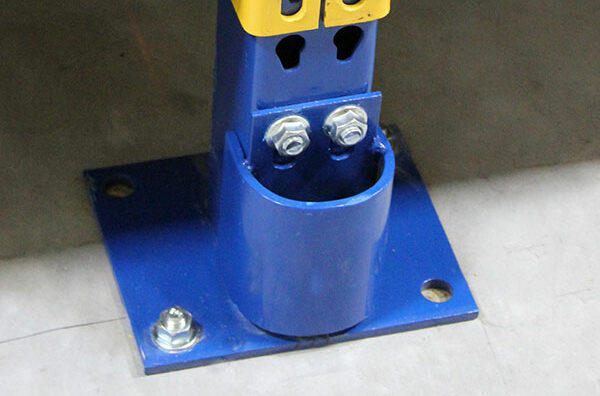
In-House Project Engineering
Our licensed structural engineers design carton flow systems from initial CAD layouts to site-specific seismic, wind, and building code compliance calculations.
Explore CapabilitiesRMI & ANSI MH16.1 Certified
Every beam, upright frame, flow track, and bracket manufactured by UNARCO RACKING strictly meets or exceeds established North American Rack Manufacturers Institute design criteria.
Automated Powder-Coat Lines
Multi-million-dollar automated finishing lines ensure superior paint coverage, scratch resistance, and long-lasting corrosion protection under continuous carton abrasion.
End-to-End Project Delivery
From initial facility testing of customer cartons to logistics staging, turnkey installation, and post-commissioning lifecycle audits, we provide a single point of accountability.
Frequently Asked Questions: Industrial Carton Flow Racks
Detailed technical answers to common queries submitted by global warehouse managers, procurement directors, and systems integrators.
What is an industrial carton flow rack and how does it optimize split-case picking?
An industrial carton flow rack is a gravity-driven storage and picking structure featuring inclined roller or wheel lanes within pallet rack bays. Unlike static shelving where stockers and pickers work in the exact same aisle, carton flow creates two independent aisles: a rear replenish aisle where full cases or totes are loaded, and a front pick aisle where individual items or entire cases are picked.
This arrangement enforces automatic FIFO (First-In, First-Out) stock rotation, essential for date-sensitive consumer packaged goods, food, pharmaceuticals, and fast-moving retail SKUs. By compressing hundreds of picking locations along an uninterrupted face, travel distances for pick workers are reduced by up to 75%, and pick productivity often increases by 50% or more compared to static bin shelving.
How do you choose between full-width roller tracks and universal wheel beds?
The decision centers on carton bottom conditions and operational SKU flexibility:
- Full-Width Roller Tracks: Best when handling a consistent range of carton footprints or heavier plastic totes. Rollers provide continuous line-contact across the package width, preventing corrugated box bottoms from sagging, bowing, or hanging up between narrow wheel rows. They are heavily favored in automotive manufacturing lines and uniform-carton logistics.
- Universal Wheel Beds: Best when handling high SKU churn with frequently changing carton dimensions, such as multi-brand 3PL fulfillment centers or e-commerce DCs. Because skatewheels cover the entire deck surface, boxes of arbitrary width can be loaded anywhere on the shelf bed without re-spacing dedicated structural track rails.
How is carton flow rack pitch calculated and what happens if the pitch is incorrect?
Standard pitch typically ranges between 3/8" (9.5 mm) and 1/2" (12.7 mm) of vertical drop per linear foot of run, translating to an incline angle between 3.0% and 4.2%. However, the precise angle must be calculated by evaluating the coefficient of rolling friction between the roller wheel material and the carton bottom surface.
If the pitch is too shallow, cartons experience static stall midway down the lane, forcing pickers to manually reach into the rack or poke with reach-sticks, introducing safety hazards and slowing picking cycles. If the pitch is too steep, heavy boxes accelerate rapidly, crashing into the front stop lip, which can cause package crush, split seams, carton overhang spillage, or repetitive jarring to workers' wrists during retrieval. UNARCO RACKING conducts physical drop testing with actual customer packaging in our engineering labs to ensure flawless glide velocities.
Can carton flow tracks be retrofitted into our existing selective pallet racking?
Yes. UNARCO RACKING carton flow tracks and wheel beds are engineered for seamless compatibility with both roll-formed teardrop step beams and structural steel C-channels. Using universal snap-in brackets or bolted mounting adapters, facilities can convert the lowest one, two, or three beam tiers of existing pallet rack into high-density split-case carton flow picking bays, while maintaining standard pallet storage on upper levels. This eliminates the expense of purchasing new structural uprights or reconfiguring aisle floor plans.
What maintenance is required on an industrial carton flow system?
Carton flow racking is inherently low-maintenance due to its passive gravity operation. Routine maintenance protocols recommend:
- Periodic vacuuming or blowing out accumulated corrugated dust, stretch-wrap fragments, and strapping debris from wheel axles.
- Visual inspection of the front pick stops and impact entry brackets for impact damage or deformed retainer clips.
- Checking beam safety locks and upright anchor bolt tightness during scheduled annual RMI rack safety audits.
Because UNARCO RACKING utilizes high-grade lubricated-for-life bearings and impact-resistant materials, bearing re-greasing is not necessary under standard ambient or dry cold-storage operating environments.
Upgrade Your Split-Case Throughput with UNARCO RACKING
Consult with our engineering team or request our technical product catalog: [email protected]