Engineered Four-Way Shuttle & Heavy-Duty Storage Configurations
Factory-calibrated structural steel arrays, multi-directional intelligent shuttles, and precision cold-formed racking assemblies custom engineered to your exact pallet metrics and structural constraints.
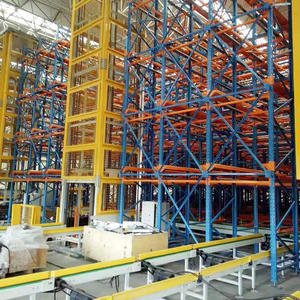
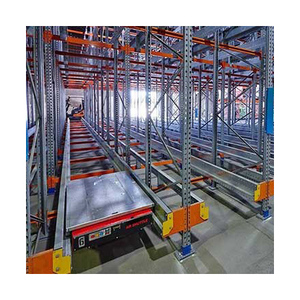
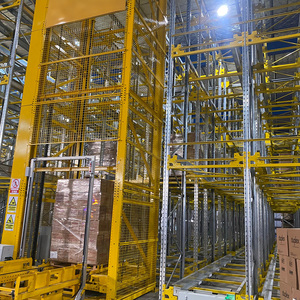
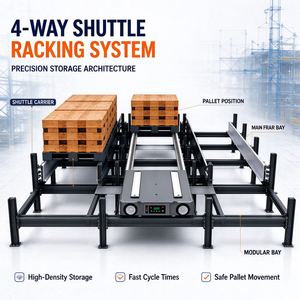
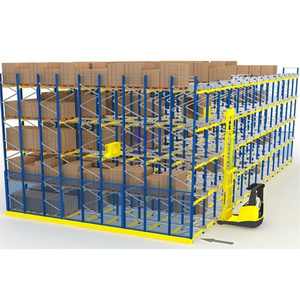
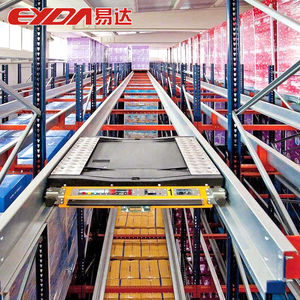
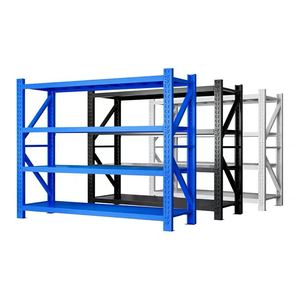
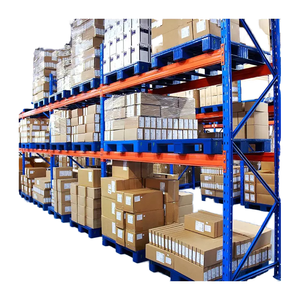
Architectural Mechanics of CE-Certified Heavy-Duty Four-Way Shuttle Systems
A comprehensive industrial appraisal of kinematics, structural steel metallurgy, track interchange tolerances, and compliance standards governing advanced high-density pallet automation.
In modern industrial warehousing, modern supply chains face soaring footprint costs, labor shortages, and rising demand for omnichannel fulfillment. Traditional storage topologies—such as static selective racking, drive-in racking, and basic push-back mechanisms—force a compromise between volumetric storage density and individual stock keeping unit (SKU) selectivity. The development of the Heavy-Duty Four-Way Shuttle Racking System eliminates this compromise, establishing a new paradigm in automated storage and retrieval systems (AS/RS).
Unlike conventional two-way radio shuttles that operate exclusively down straight lanes, a four-way shuttle platform moves across both longitudinal and transverse axes. Coupled with dedicated high-speed vertical reciprocating lifts (lifters), the shuttle vehicle navigates dynamic 3D coordinate space (X, Y, and Z axes). This spatial mobility enables individual pallet accessibility, automated SKU sorting, cross-lane sequencing, and intelligent buffer balancing—all within an ultra-dense cubic matrix that minimizes unused aisle space.
Structural Metallurgy & Roll-Forming Precision
Fabricated using certified Q235B and high-yield Q355B structural steel, our uprights and shuttle tracks undergo high-precision progressive continuous roll-forming. Profile deviation is kept within ±0.5mm across a 12-meter continuous span, eliminating micro-jolts during shuttle transitions and preventing vibration-induced wear on sensitive mechanical drives.
Dual-Directional Motion & Rail Steering
The four-way vehicle uses an electro-hydraulic or servo-driven wheel-lifting mechanism that smoothly toggles between longitudinal running wheels and transverse transfer wheels in under 2.5 seconds. Integrated polyurethane drive wheels maintain optimal tractive friction against galvanized precision track profiles, preventing slippage under maximum load accelerations up to 1.2 m/s².
CE-Certified Safety Interlock Architecture
Fully compliant with CE Machinery Directive 2006/42/EC and EN ISO 13849-1 Safety of Machinery (PL d / Cat 3), each automated rover features multi-level safety infrastructure: dual safety laser scanners (TOF ranging), ultrasonic barrier detectors, mechanical collision bumpers, rail-drop prevention interlocks, and emergency deceleration triggers.
Engineering Matrix: Four-Way Shuttle vs. Conventional Storage Topologies
Compare mechanical, spatial, and functional characteristics across industrial warehouse architectures to evaluate volumetric efficiency, equipment capital allocation, and total throughput capacity.
| Evaluation Parameter | 4-Way Autonomous Shuttle AS/RS | 2-Way Radio Shuttle System | VNA (Very Narrow Aisle) Racks | Stacker Crane AS/RS System |
|---|---|---|---|---|
| Volumetric Space Utilization | Extreme (85% - 92%) | High (70% - 80%) | Moderate (55% - 65%) | High (75% - 85%) |
| Payload Capacity per Unit | 500 kg – 1,500 kg (Heavy Duty) | 1,000 kg – 1,500 kg | 1,000 kg – 2,000 kg | 1,000 kg – 3,000 kg |
| Horizontal Velocity (Full Load) | 1.2 m/s – 1.5 m/s | 0.8 m/s – 1.0 m/s | Manual Truck Dependant | 2.0 m/s – 4.0 m/s |
| Z-Axis Tier Transfer Flexibility | High (Via Reciprocating Lift) | Low (Requires Forklift Transfer) | Manual Operation Only | Dedicated Single-Aisle Mast |
| SKU Selectivity & Sorting | 100% Dynamic Random Access | Batch / Channel Dependent | 100% Direct Access | 100% Direct Access |
| System Redundancy & Scalability | Dynamic Swarm (Add rovers anytime) | Medium (Add shuttles) | High (Add trucks) | Low (Crane outage halts aisle) |
| Civil Foundation Sensitivity | Moderate (DIN 18202 Class 3) | Standard Industrial Slab | High (Superflat Floor required) | Extreme (Heavy point loads) |
| Cold Storage Adaptability | -25°C to -30°C (Cold-spec LiFePO4) | -25°C (Limited cycle life) | Requires heated cabins | Fully operable |
Future Procurement Trends in Industrial Pallet Automation
Emerging procurement patterns reveal how global supply chain leaders are structuring capital investments to achieve lower total cost of ownership (TCO) and rapid system commissioning.
Brownfield Retrofits Over Greenfield Real Estate
As global industrial land prices remain high, procurement teams are shifting focus from acquiring new property to retrofitting existing brownfield facilities. Four-way shuttle systems adapt to irregular warehouse layouts, variable ceiling heights, and building columns, increasing storage capacity within existing footprints by up to 250%.
Cold-Chain Thermal Integrity & Carbon Neutrality
Energy consumption in refrigerated and deep-freeze logistics (-18°C to -30°C) is directly proportional to warehouse cubic volume. High-density four-way shuttle matrices minimize unused air space, reducing cooling loads by up to 35%. Procurement teams prioritize systems equipped with low-temperature supercapacitors or heated lithium iron phosphate (LiFePO4) power cells.
Modular Phased Capital Deployment
Unlike traditional stacker crane AS/RS solutions that demand massive initial capital expenditures, four-way shuttle architectures allow modular capital expenditure. Operators can install the complete steel racking structure during Phase 1, then scale their vehicle fleet dynamically over time as SKU turnover and order volume increase.
Technological Evolution: Next-Gen Autonomous Shuttle Intelligence
How advances in edge computing, industrial wireless protocols, and algorithmic warehouse control systems are shaping the future of four-way pallet automation.
The transition from remote-controlled, semi-automatic shuttle cars to fully autonomous four-way robotic fleets marks an inflection point in high-bay logistics. Contemporary systems integrate deeply with Warehouse Management Systems (WMS) and Warehouse Execution Systems (WES), powered by real-time Warehouse Control Systems (WCS) operating on low-latency microservice architectures.
Three primary technological frontiers are reshaping modern four-way shuttle engineering:
AI Fleet Swarm Intelligence & Dynamic Dispatch
Using decentralized collision-avoidance algorithms and graph neural network pathfinding, multi-vehicle fleets recalculate routing around high-density choke points in milliseconds. Shuttles coordinate with vertical lifters to schedule picks, buffer replenishment, and sort SKUs dynamically during low-activity off-peak hours.
Industrial 5G & Zero-Packet-Loss Wi-Fi 6
Traditional industrial radio networks often suffer from signal attenuation and handoff latency within dense steel racking matrices. Modern four-way shuttle installations deploy Wi-Fi 6 roaming protocols or dedicated private 5G mmWave micro-cells, guaranteeing handoff latency under 10 milliseconds and maintaining real-time telemetry across thousands of node coordinates.
Regenerative Braking & Fast-Charge Supercapacitors
Next-generation shuttles incorporate regenerative descent braking and kinetic energy recovery systems (KERS), returning up to 18% of deceleration energy back to on-board storage. Paired with high-rate supercapacitor bus-bar charging stations located on vertical lifters, shuttles recharge in under 2 minutes for 30 minutes of continuous runtime.
Why Global Supply Chains Trust Our Engineered Storage Systems
With nearly 70 years of precision manufacturing, our facilities combine certified heavy-duty structural steel production, advanced automation, and turnkey project accountability.
In-House Structural & Seismic Engineering
Every high-density shuttle racking structure is engineered in-house to RMI / ANSI MH16.1 specifications and Eurocode 3 standards. Our registered structural engineers run complex Finite Element Analysis (FEA) models to evaluate dynamic seismic loads, floor slab anchoring embedments, and vibration resonance across every installation site.
Automated Pretreatment & Powder Coating
Our manufacturing campus features multi-million-dollar automated electrostatic powder coating lines. Utilizing continuous shot-blasting, multi-stage zinc-phosphate chemical washing, and thermo-cured epoxy polyester coatings, our rack members deliver superior resistance against corrosion, impact abrasion, and chemical exposure in humid or sub-zero environments.
Turnkey Accountability: From CAD to Commissioning
We provide complete end-to-end project management. From initial site surveying and pallet profile characterization to precision laser-guided assembly, WCS software integration, and full payload stress testing, a single engineering team manages every phase of delivery, avoiding subcontractor handoff risks.
Frequently Asked Questions: Four-Way Shuttle Specifications
Direct technical answers to common questions asked by supply chain executives, warehouse planning consultants, and corporate engineering directors.
What are the concrete slab flatness and levelness requirements for a 4-way shuttle rack?
How does the four-way shuttle system transition between different vertical storage levels?
What safety standards and CE directives apply to automated four-way shuttles?
How does the shuttle system perform in sub-zero and deep-freeze logistics (-30°C)?
What is the typical battery charging protocol and expected cycle life?
Can non-standard or damaged wooden pallets be handled safely?
What is the typical Return on Investment (ROI) period compared to conventional warehousing?
Request a Turnkey Engineering Design & System Layout
Send your facility drawings (DWG/CAD), clear ceiling heights, pallet parameters, and throughput requirements. Our structural and automation engineering team will prepare a custom layout proposal, seismic load calculations, and total cost of ownership budget within 48 hours.
Contact Us