Featured Heavy-Duty Wire Deck Pallet Racking Systems
Precision-manufactured roll-formed teardrop and heavy structural channel configurations. Every bay is optimized with reinforced wire mesh decking to satisfy stringent ANSI MH26.2 safety standards and NFPA 13 fire sprinkler open-area requirements.
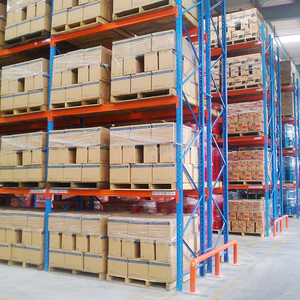
Combined Load-Row Connected Industrial Pallet Racking System Heavy Duty Warehouse Storage Racks 2000kg Steel
- Payload Rating: 2000 kg UDL
- Upright Profile: 90mm × 70mm × 2.0mm
- Beam Section: 100mm × 50mm Step
- Deck Type: Inverted Flange Wire Deck
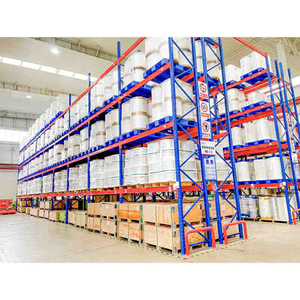
Racking Heavy Duty High Quality Warehouse Storage Rack Commercial Metal Wire Mesh Decking Pallets Racking Shelves
- Mesh Gauge: 5.0mm (6-Gauge Steel)
- Channel Supports: 3-4 Welded Ribs
- Finish: Electro-Galvanized / Powder
- Compatibility: Universal Step Beams
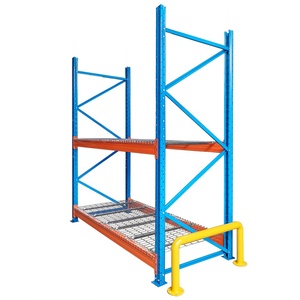
2500kg Layer Load Warehouse Storage Pallet Shelving Rack with Wire Mesh Decking
- Beam Capacity: 2500 kg / Tier
- Deflection Limit: L / 250 Standard
- Channel Gauge: 14-Gauge High Tensile
- Safety Factor: 1.67 RMI MH16.1 Design
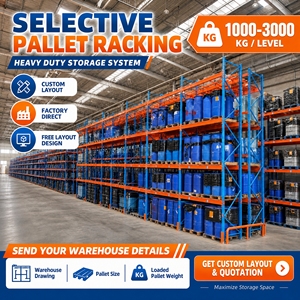
High Quality Teardrop Pallet Rack System Low Price High Load Heavy Duty Warehouse Selective Pallet Racking for Wire Mesh Deck
- Connection: Interchangeable 2" Pitch
- Safety Pins: Gravity Auto-Lock Plunger
- Grid Pattern: 2" × 4" Wire Matrix
- Standard Sizes: 36", 42", 48" Depths
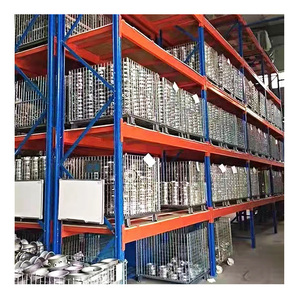
Pallet Racking Warehouse Storage Heavy Duty Industrial Pallet Shelf Narrow Aisle Selective Warehouse Racking System
- Aisle Width: 1600mm - 1900mm (VNA)
- Height Limit: Up to 15,000mm Vertical
- Deck Safety: Drop-In Flush Mount Deck
- Guide Options: Floor Angle / Wire Guidance
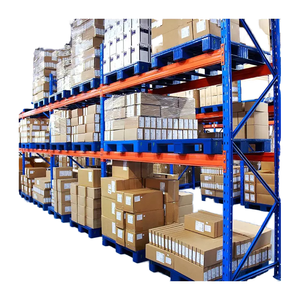
Heavy Duty Selective Pallet Rack Metal Q235 Seismic Reinforced Wire Mesh Protection Epoxy Coated Supporting Smart Warehouse
- Steel Alloy: Certified Q235B / Q355B
- Seismic Baseplate: Enlarged & Anchored Dual-Hole
- Coating: Electrostatic Epoxy 80μm
- Automation: AMR / AGV Rail Integration
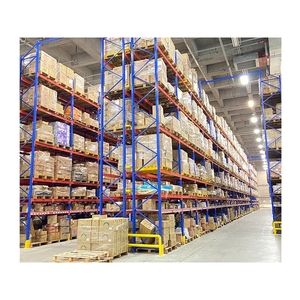
Warehouse Racking System Heavy Duty Industrial Steel Shelving Warehouse Pallet Racks For Sale
- Beam Options: Boxed / Step Section Roll-form
- Wire Diameter: 4.5mm - 6.0mm Carbon Steel
- Safety Compliance: OSHA & ANSI MH16.1
- Export Standard: Bundled / Palletized Crated
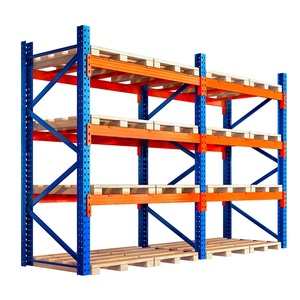
Industrial Heavy Duty Storage Shelves Systems Stacking Units Metal Rack Warehouse Steel Pallet Racking
- Upright Splice: Heavy Bolted Splice Kits
- Impact Resistance: Reinforced Post Protectors
- Deck Channel: Heavy Flare Channel Welded
- Payload Range: 1000kg - 4500kg / Tier
Structural Architecture of Wire Deck Pallet Racking Systems
An in-depth analysis of metallurgical specifications, load deflection formulas, seismic shear forces, and NFPA 13 sprinkler water-permeability compliance for heavy industrial logistics facilities.
Modern distribution centers, automated 3PL fulfillment hubs, and heavy manufacturing warehouses face unprecedented storage density demands. The integration of heavy-duty roll-formed selective pallet racking with welded wire mesh decking has established itself as the global industry benchmark for versatile, safe, and code-compliant storage. Unlike obsolete solid timber decking or smooth sheet metal platforms, wire deck racking delivers an uncompromised structural balance between uniformly distributed load (UDL) capacity, point load resilience, ventilation, and emergency fire mitigation.
RMI ANSI MH16.1 & MH26.2 Compliance Requirement: Steel storage racks must maintain a minimum structural safety factor of 1.67 under static dead-and-live loads. Furthermore, ANSI MH26.2 mandates that wire deck deflection shall not exceed L/200 under rated uniformly distributed load conditions, eliminating systemic sag and localized post-buckling failures.
1. Metallurgical Profiles: High-Yield Structural Q235B vs. Q355B Steel
The operational longevity of a heavy-duty racking bay begins at the rolling mill. Upright frames and load beams are roll-formed from certified high-strength cold-rolled carbon steel coils conforming to ASTM A1011 or GB/T 700 standards (Grade Q235B and Q355B). For heavy commercial and seismic applications, Q355B offers a minimum yield strength of 355 MPa, delivering superior elastic limits against repeated forklift docking impacts and vertical compressive loads compared to standard commercial mild steel.
Uprights are cold-punched with CNC-precision tooling along an automated 50mm or 76.2mm (2" to 3") modular pitch. Roll-formed upright geometry utilizes continuous closed-omega or multi-rib open-channel configurations that maximize the radius of gyration ($r$), effectively dampening torsional buckling along the unbraced column length ($Kl/r$).
2. Wire Deck Anatomy: Gauges, Mesh Grids, and Channel Profiles
A wire mesh deck consists of bright basic drawn steel wire (typically 4.5mm to 6.0mm diameter, corresponding to 7-gauge to 4-gauge US standard) resistance-welded at every intersection into a rigid 50mm × 100mm (2" × 4") or 50mm × 50mm (2" × 2") grid. The structural load-carrying capacity of the deck, however, is primarily governed by the cold-formed support channels robotically welded beneath the wire mesh:
- Standard Step Channel: Features formed vertical flanges that drop flush into the 7/8" or 1-5/8" interior step of roll-formed step beams. This eliminates snag points when pallet forks penetrate the bay and prevents horizontal displacement under lateral dragging forces.
- Universal Flared Channel: Engineered with flattened horizontal wings on each terminal end, allowing the deck to rest securely on structural steel C-channel beams, box beams, or roll-formed beams lacking an internal step. Flared channels distribute vertical shear evenly across the top flange of the beam.
- Inverted Step Channel: Designed specifically for cleanroom, pharmaceutical, and high-hygiene food storage facilities. The channel profile is oriented inverted (open side downward) to prevent accumulation of dust, wood pallet splinters, and airborne debris within the channel cavity.
| Deck Model / Application | Wire Diameter (mm) | Mesh Pattern (mm) | Support Channels | Rated UDL Capacity | Sprinkler Permeability |
|---|---|---|---|---|---|
| Standard Commercial Tier | 4.8 mm (±0.05) | 50 × 100 (2" × 4") | 3 × 14-Gauge Step | 1,000 kg (2,200 lbs) | > 72% Open Area |
| Heavy Industrial Logistics | 5.0 mm (±0.05) | 50 × 100 (2" × 4") | 4 × 14-Gauge Step | 1,500 kg (3,300 lbs) | > 70% Open Area |
| Ultra Heavy-Duty Mining/Auto | 5.8 mm (±0.05) | 50 × 75 (2" × 3") | 5 × 13-Gauge Flared | 2,500 kg (5,500 lbs) | > 65% Open Area |
| Cold Storage / Food Grade | 5.0 mm Electro-Galv. | 50 × 100 (2" × 4") | 4 × Inverted Sanitary | 1,250 kg (2,750 lbs) | > 70% Open Area |
| Small-Parts Carton Flow / Picking | 4.0 mm (±0.05) | 25 × 50 (1" × 2") | 3 × Light Step | 600 kg (1,320 lbs) | > 58% Open Area |
3. Fire Safety Dynamics: NFPA 13 Sprinkler Penetration & Insurance Compliance
Solid wood decks and corrugated solid steel panels create catastrophic horizontal barriers to overhead fire sprinkler systems. When water discharges, solid surfaces create a ceiling umbrella effect, channeling heat lateral to adjacent bays while preventing water from reaching combustion points on lower rack tiers. In stark contrast, open wire mesh decking engineered with a minimum of 50% to 70% open surface area allows unrestricted water droplet penetration straight through to the warehouse floor. This complies strictly with NFPA 13 (Standard for the Installation of Sprinkler Systems) and FM Global Property Loss Prevention Data Sheets 8-9, frequently qualifying warehouse operators for lower commercial property insurance underwriting premiums.
Nearly 70 Years of Engineered Pallet Rack Manufacturing Excellence
Drawing upon nearly 70 years of pioneering structural engineering lineage, our automated production facilities transform prime steel into RMI-compliant roll-formed and structural pallet rack assemblies. From Fortune 500 distribution operations to multi-national cold-chain terminals, we engineer the physical backbones that keep global supply chains moving safely.
Strict RMI & ANSI MH16.1 Design
Full compliance with Rack Manufacturers Institute (RMI) standards. Every column, beam weldment, and connector clip is third-party strain-gauge tested for cyclic elastic fatigue and ultimate collapse safety margins.
Automated Powder Coat Lines
Multi-million dollar continuous automated powder-coating lines with zinc-phosphate multi-stage wash pretreatment. Provides a 70–90μm durable thermoset epoxy finish that resists scratches, chemicals, and humidity.
Seismic & Foundation Engineering
Custom anchor embedment calculations based on ACI 318 Appendix D, concrete slab thickness, and localized USGS/IBC seismic acceleration maps to specify custom enlarged baseplates and chemical anchors.
Future Procurement Trends in Heavy-Duty Wire Deck Pallet Racking
How supply chain directors, industrial EPC contractors, and procurement managers are shifting procurement specifications to optimize total lifecycle cost, carbon transparency, and automation compatibility.
Decarbonized EAF Steel & EPD Auditing
Global enterprise buyers are mandating Environmental Product Declarations (EPDs) under ISO 14025. Procurement contracts increasingly reward suppliers utilizing Electric Arc Furnace (EAF) steel with recycled scrap content exceeding 75%, slashing Scope 3 embodied carbon footprints for LEED-certified distribution facilities.
Tight-Tolerance AS/RS & Shuttle Decks
With the exponential deployment of Autonomous Mobile Robots (AMRs) and automated 4-way pallet shuttles, standard commercial racking tolerances (±3.0mm) are being replaced by high-precision fabrication (±1.0mm). Wire decking is now engineered with recessed, laser-cut locator channels to facilitate robotic optical navigation.
Hybrid Roll-Formed & Structural Systems
Procurement strategies are abandoning all-or-nothing framing in favor of hybrid designs: heavy-duty structural C-channel columns for the bottom 60 inches where forklift impact accounts for 85% of rack damage, combined with cost-efficient roll-formed teardrop uprights above the first load level.
Containerized Sea-Freight Optimization
With volatile oceanic shipping tariffs, intelligent OEM pallet rack engineering focuses heavily on nested bundle geometries. Nesting flared wire decks into interlocking stack blocks cuts ocean freight container volume by up to 34%, dramatically reducing landed cost per pallet location.
Micro-Galvanized Anti-Bacterial Formulations
Cold storage, pharmaceuticals, and fresh grocery hubs are accelerating demand for dual-coated hot-dip galvanized (HDG) wire decks supplemented with antimicrobial topcoats that resist aggressive wash-down sanitation chemicals, preventing pitting corrosion and bacterial retention.
Sensor-Integrated Digital Twin Racking
Future-ready facilities are pre-specifying racks with pre-drilled wireless telemetry ports to accommodate piezoelectric strain sensors and 3-axis impact monitors. Racks now communicate real-time structural health, beam overload alerts, and seismic displacement directly to cloud-based WMS platforms.
Technological Innovations in Pallet Rack & Decking Fabrication
Advanced manufacturing methodologies that enhance structural load predictability, joint rigidity, and cyclic fatigue life in high-throughput warehouse environments.
The manufacturing paradigm for industrial racking has transitioned from traditional manual cut-and-weld shops to fully automated, digitally monitored fabrication corridors. These technological advancements ensure that every batch of cold-formed steel and welded wire decking satisfies rigorous structural tolerance envelopes.
1. Multi-Point Robotic Resistance Welding vs. Flux MIG Welding
Historically, support channels were hand-welded to the wire mesh fabric using gas metal arc welding (MIG). This introduced localized heat-affected zones (HAZ) that annealed the cold-drawn steel wire, causing metallurgical brittleness and premature weld failure under cyclic live loading. Modern automated production lines utilize computerized multi-head capacitor discharge resistance spot welding. By applying precise electrical current and pneumatic clamp pressure simultaneously within milliseconds, fusion occurs at the atomic level without altering the adjacent tensile crystalline structure of the cold-drawn wire.
2. Advanced Finite Element Analysis (FEA) Modeling for Beam-to-Column Connectors
The beam-to-column connector is the critical semi-rigid moment connection that determines the unbraced frame sway stability of an entire selective rack bay. Through advanced non-linear Finite Element Analysis (FEA) and physical portal frame testing according to ANSI MH16.1 Section 9.4, connector clips are now optimized with 3-pin or 4-pin tapered lugs. These lugs wedge downward into matching teardrop punchouts, establishing an initial rotational stiffness ($F_m$) that minimizes frame lateral drift during seismic events and eliminates the requirement for rear cross-bracing in standard selective aisle depths.
3. Pretreatment & Electrostatic Powder Nano-Ceramics
Corrosion resistance on uprights and beams has been upgraded through the introduction of zirconium-based nano-ceramic pretreatment rinses, replacing traditional iron phosphate baths. This environmentally responsible chemistry produces an ultra-dense chemical conversion layer that enhances mechanical adhesion for the subsequent electrostatic epoxy powder coating. The resulting surface finish exceeds 1,000 hours of continuous neutral salt spray exposure (ASTM B117 / ISO 9227) without filiform creep, blister delamination, or loss of specular gloss.
Frequently Asked Questions: Wire Deck Pallet Racking
Essential technical, structural, and international logistics clarifications for supply chain engineers, facility managers, and B2B buyers.
What is the difference between Uniformly Distributed Load (UDL) and Concentrated Point Load on wire decking?
Why is wire mesh decking strongly preferred over solid wood or steel decking under NFPA 13 codes?
How do site-specific seismic categories (SDC A through F) alter upright and anchorage engineering?
Can teardrop roll-formed pallet racking components from different manufacturers be safely interchanged?
What finish should be specified for humid, refrigerated, or outdoor warehouse conditions?
How are heavy-duty pallet racks packaged and secured for international ocean container export?
Accelerate Your Storage Efficiency with Custom Engineered Solutions
Whether you require certified seismic-zone warehouse layouts, custom wire deck loading configurations, or full OEM containerized export pricing, our professional application engineers are ready to assist you.