Drive-In Series
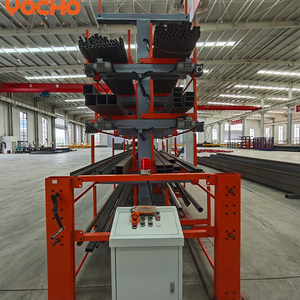
Explore our turnkey, OEM-certified industrial pallet racking configurations designed for high-density warehouse throughput, maximum footprint utilization, and extreme structural longevity.
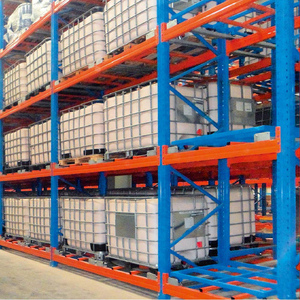
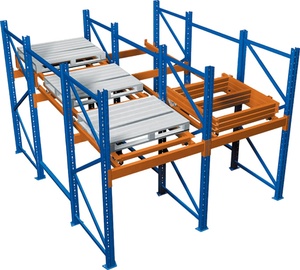
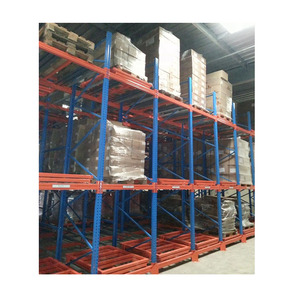
A rigorous industrial perspective on optimizing cubic volume, minimizing forklift transit distances, and mitigating dynamic cart inertia in modern distribution centers.
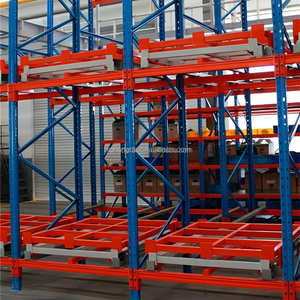
Push back pallet racking is fundamentally an engineered dynamic storage medium that leverages a nested cart configuration rolling along inclined structural steel rails. Unlike standard static selective pallet racks that demand extensive aisle-to-storage floor ratios, or drive-in racks that mandate lift trucks physically entering the rack bays, push back architecture achieves high-density LIFO (Last-In, First-Out) inventory control while preserving strict aisle exclusivity.
When loading, the forklift places the initial pallet onto the top nested rolling cart. When introducing the subsequent pallet, the forklift driver utilizes the second unit load to gently push back the first pallet, exposing the underlying cart. This cascading nesting sequence continues up to 6 pallets deep. Upon retrieval, gravitational deceleration smoothly advances trailing pallets toward the pick face as the front pallet is extracted, controlled by precision-engineered inclination angles typically calibrated between 1.5° and 3.0° (approx. 2.5% to 5.0% grade).
Our OEM factory integrates hot-rolled structural steel channel front beams and reinforced push back carts equipped with high-capacity steel wheels and sealed bearings. This prevents flange fatigue, cart distortion, and binding under eccentric pallet loads of up to 3,000 lbs (1,360 kg) per cart.
Engineers evaluate two mechanical variants when specifying push back solutions: multi-tiered nested carts versus full-lane dynamic roller beds. While roller systems excel in specific uniform container scenarios, the nested cart system represents the definitive global benchmark for multi-depth pallet logistics due to superior durability, immunity to broken pallet bottom boards, and lower maintenance downtime. Because each pallet rests on its own rigid welded steel cart frame rather than individual spinning rollers, load point distribution remains mathematically uniform across the structural rail channels.
Furthermore, custom OEM push back fabrications allow for specialized carrier pocketing, bespoke wheel flange geometries, and integrated anti-lift mechanical interlocks. These mechanical stops ensure that carts cannot jump tracks during rapid decelerations or accidental erratic forklift handling.
A rigorous empirical comparison evaluating push back technology against conventional selective, drive-in, and dynamic pallet flow systems.
| Racking Architecture | Density Index | Selectivity Profile | Rotation Logic | Forklift Impact Risk | Ideal Application Criteria |
|---|---|---|---|---|---|
| Push Back (Nested Cart) | High (85-90%) | 1 SKU per lane face | LIFO | Extremely Low (No entry into bays) | Medium-velocity SKUs, 2-6 pallets per lot, cold room optimization |
| Standard Selective Rack | Moderate (50-60%) | 100% Immediate | FIFO / LIFO | Low (Aisle operations) | High SKU count, single-pallet orders, high-turnover fulfillment |
| Drive-In / Drive-Thru | Very High (85-95%) | Low (1 SKU per tunnel) | LIFO (Drive-in) / FIFO | High (Masts operate inside structure) | Mass homogeneous inventory, seasonal staging, bulk raw ingredients |
| Pallet Flow (Gravity Roller) | Maximal (90-95%) | 1 SKU per deep lane | Strict FIFO | Low (Dedicated load/pick aisles) | Perishable foodstuffs, high-volume fast-moving consumer goods |
| AS/RS Precision Structure | Extreme (95%+) | Automated Dynamic | Algorithm-driven | Zero (Robot-handled cranes) | High-throughput mega-hubs, labor-constrained regional facilities |
Anticipate how supply chain automation, cold chain expansion, and ESG-compliant manufacturing alter industrial push back racking specifications.
Global frozen food and biologic cold chain storage are surging. Conventional lubricated roller bearings bind or seize at -25°C. Modern push back procurement trends mandate vacuum-degassed chrome-steel wheel bearings with synthetic low-temperature fluorinated lubricants, ensuring zero freeze-ups and continuous cart rollability without maintenance intervention.
Push back rack is rapidly transitioning from manual counterbalance forklift operations to autonomous guided vehicle (AGV) interfacing. Next-generation push back lanes incorporate precision optical target plates, laser-aligned cart homing stops, and reinforced push-face bumpers that tolerate automated mast approach tolerances down to ±2 millimeters.
Tier-1 multinational enterprises now demand Scope-3 emissions transparency. Forward-looking OEM push back suppliers utilize electric arc furnace (EAF) steel with up to 90% recycled content. Combined with automated VOC-free electrostatic powder coat finishing lines, modern racking systems fulfill LEED certification criteria without sacrificing yield strength.
A deep engineering review of seismic anchor embedment, slab load dissipation, and post-impact mitigation for push back installations.
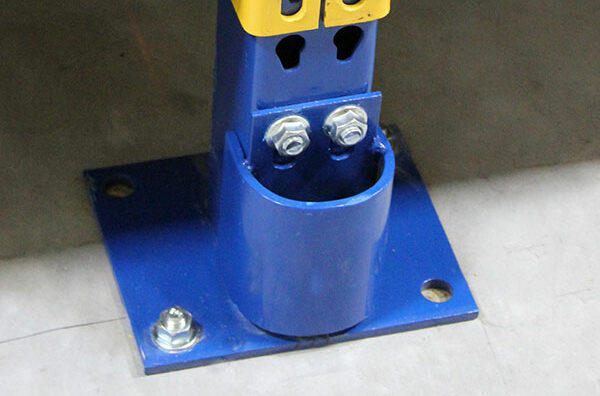
Front upright columns in push back bays face repeated tangential contact during pallet loading. Our heavy-gauge steel straddle guards disperse direct impacts safely into the slab, preventing structural frame deformation and preserving load-bearing integrity.
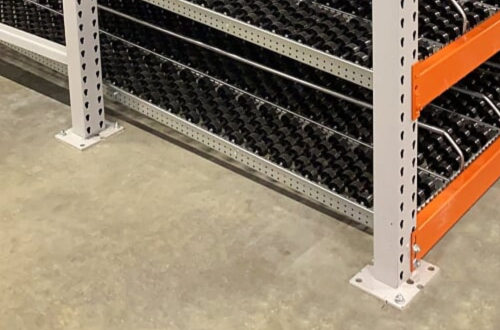
Seismic compliance under IBC 2024 and RMI ANSI MH16.1 hinges on nominal versus effective embedment depth. Heavy-duty wedge and screw anchors ensure that the overturning moment generated by high-density nested carts is firmly resisted by sound concrete.
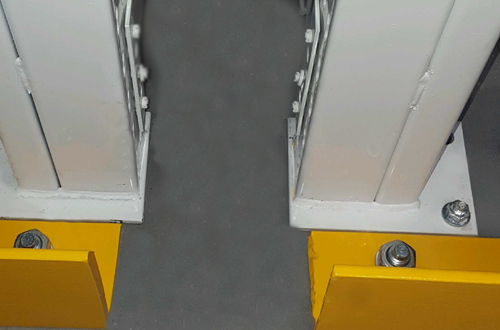
Push back systems concentrate tremendous point loads through baseplates. Our project engineers evaluate compressive strength (PSI), slab thickness, and expansion joint proximities to prevent slab punch-through or anchor cone blowouts under peak load ratings.
Combining nearly 70 years of material handling engineering with massive automated fabrication lines to deliver certified storage infrastructure worldwide.
Decades of proprietary engineering know-how, delivering bespoke push back, flow, and structural racking systems to Fortune 500 supply chain leaders across the globe.
Every frame, cart rail, weldment, and connection pin is calculated and tested in strict conformance with North American and European seismic and safety codes.
We manufacture both structural channel steel (for severe impact and extreme load zones) and roll-formed high-tensile steel (for modularity and cost-effective layout scalability).
Multi-million-dollar automated electrostatic powder coating facilities ensure uniform mil-thickness, superior corrosion resistance, and customized corporate color matching.
Essential technical clarifications addressing load clearances, wheel bearing maintenance, cart binding, and seismic certifications.
Push back pallet systems are commonly engineered between 2 and 5 pallets deep per lane. While 6-deep configurations are technically viable and deployed in select high-density facilities, they require high-capacity lift trucks capable of generating sufficient pushing force without drive-wheel slipping. For lanes deeper than 6 pallets, our engineering team typically recommends transitioning to dynamic pallet flow (gravity roller FIFO) or radio shuttle deep-lane automation.
Our OEM push back systems incorporate three essential engineering safeguards: First, carts utilize precision heavy-duty flanged steel wheels configured on hardened guide rails to ensure absolute linear tracking. Second, low-profile mechanical anti-lift clips physically interlock consecutive carts, preventing tipping during abrupt acceleration or eccentric forklift pushing. Third, nested carts feature integrated guide stops and safety retaining catches that halt movement if a pallet is loaded improperly out of square.
Because push back rails are built on a continuous incline (typically 3/8-inch per foot, or roughly 3% slope), the rear of each storage lane sits higher than the front pick beam. For a 4-deep system, the back rail elevation is approximately 4 to 6 inches higher than the front beam. Warehouse designers must factor this vertical rise plus the nested cart stack height (approx. 5 to 7 inches total) into clear overhead building clearance, sprinkler head proximities, and maximum forklift mast reach limits.
Yes, push back racking is one of the premier storage choices for refrigerated and blast-freezer warehouses where floor space carries enormous energy costs. For sub-zero operations (down to -30°C / -22°F), our factory outfits carts with specialized cold-temperature sealed stainless steel or carbon steel bearings packed with low-viscosity synthetic grease. This eliminates bearing seizure and ensures predictable gravity rolling speeds regardless of ambient frost.
To provide an exact structural quote and layout drawing, our engineering desk requires: (1) Architectural CAD floor plan showing building columns, clear heights, and slab joint positions; (2) Pallet dimensions (Width x Depth x Height, including product overhang); (3) Minimum and maximum pallet load weights; (4) Forklift model, mast height, and turning radius; and (5) Facility geographic location to calculate site-specific seismic design category (SDC) accelerations per ANSI MH16.1 specifications.