High-Density Gravity Pallet Flow: Physics, Kinematics, and Structural Resilience
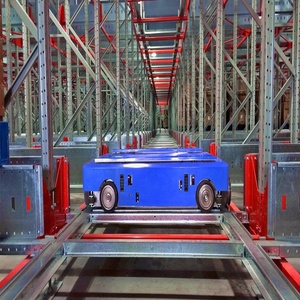
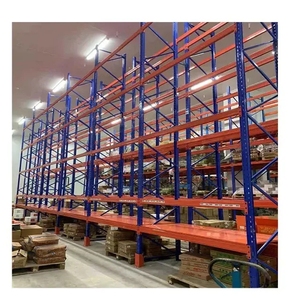
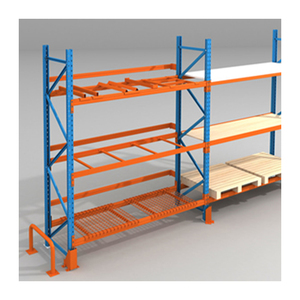
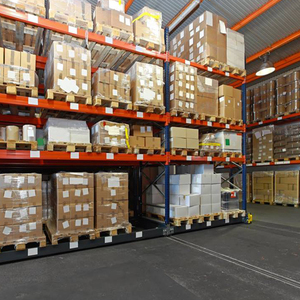
Modern automated distribution and cold-chain consolidation facilities face an unrelenting operational imperative: maximizing volume utilization while sustaining relentless inventory throughput. Heavy Duty Pallet Flow Racking, commonly engineered as dynamic gravity flow storage, operates on a high-density, First-In, First-Out (FIFO) paradigm that slashes forklift travel distances, consolidates aisle real estate by up to 60%, and optimizes floor footprint. Unlike static selective racking or low-velocity push-back systems, a heavy-duty pallet flow structure is a complex, live dynamic installation governed by gravity, kinetic braking mechanics, roller bearing resistance, and structural column elasticity.
Procuring an industrial-grade pallet flow system requires comprehensive engineering validation beyond static weight capacities. The integration of structural channel steel versus roll-formed steel profiles, centrifugal speed-controller braking drums, self-energizing ramp stops, and engineered pitch incline calculations (typically between 3/8" to 1/2" per linear foot) dictates whether a system operates seamlessly for decades or suffers chronic pallet strandings, dynamic runaway impacts, and structural fatigue. This comprehensive whitepaper evaluates the world’s top 10 heavy duty pallet flow racking manufacturers, maps future technical procurement trends, outlines seismic anchoring criteria, and provides procurement directors with an empirical decision framework.
Global Benchmark Evaluation
Top 10 Heavy Duty Pallet Flow Racking Manufacturers & Factories
Evaluated against structural yield strength, braking roller tolerances, seismic compliance (ANSI MH16.1 / EN 15512), and custom engineering depth.
With nearly 70 years of manufacturing dominance, UNARCO stands as the industry vanguard for rugged industrial warehousing. UNARCO’s pallet flow systems utilize thick structural steel channels resistant to massive forklift collisions, making them the gold standard for punishing freezer facilities and heavy beverage consolidation centers. Supported by automated powder-coat lines and proprietary engineering apps, their capacity calculations provide maximum safety margins.
Compliance: ISO 9001, ISO 14001, EN 15512, RMI Standards
Flow Tech: Dual-roller gravity tracks, entry guide systems
Mecalux provides extensive global distribution capabilities and highly automated production facilities. Their dynamic flow lines are engineered with high precision, balancing economical cold-rolled steel designs with robust split-roller assemblies that ensure consistent tracking of irregular pallets.
High ThroughputDual-Track RollersAutomated Fab
Frazier Industrial
Rank #3 (USA)
Core Strengths: 100% structural steel channel fabrication, heavy impact resilience
Compliance: RMI, AISC Structural Welding Codes
Flow Tech: Deep-lane gravity flow beds up to 20 pallets deep
Frazier is synonymous with structural channel steel racking. Rejecting roll-formed steel for heavy storage, Frazier’s pallet flow systems are tailor-made for harsh industrial abuse. Their heavy-duty uprights and bolted channel beams resist torsional twisting under high kinetic braking loads.
Pure StructuralHeavy ImpactBeverage Sector
SSI Schaefer
Rank #4 (Germany)
Core Strengths: Automated material handling integration, high-precision engineering
Compliance: FEM, EN, DIN Standards, CE Certified
Flow Tech: Magnetic braking rollers, automated separator stops
Germany’s SSI Schaefer excels in integrated automated logistics. Their pallet flow components are manufactured with tight mechanical tolerances, featuring frictionless bearings and wear-resistant polymer rollers suited for integration with automated stacker cranes and AGVs.
Industry 4.0Magnetic BrakesAS/RS Integration
Stow Group
Rank #5 (Belgium)
Core Strengths: Automated high-bay racking, European logistics market leadership
Compliance: EN 15512, ISO 9001, FEM 10.2.02
Flow Tech: Dynamic roller tracks with progressive safety braking
Stow Group provides high-volume, cost-optimized racking systems across Europe and North America. Their dynamic pallet flow systems feature specialized galvanized wheel tracks designed to operate in extreme sub-zero cold storage without bearing lockup.
Galvanized TracksEuropean QualityCold Chain
BITO-Lagertechnik
Rank #6 (Germany)
Core Strengths: Order picking modules, modular flow bed configurations
Compliance: DIN EN ISO 9001, RAL Quality Mark RG 614
BITO specializes in dynamic storage ergonomics and order picking efficiency. Their heavy-duty pallet live storage modules feature integrated safety separators that prevent rear line pressure on the front pick face, safeguarding picking operators during SKU retrieval.
Compliance: FEM European Guidelines, ISO 14001, CE
Flow Tech: Heavy-duty dynamic gravity lanes with end-stop dampers
Jungheinrich designs heavy-duty pallet flow systems optimized around automated reach trucks and VNA machinery. Their rack uprights and dynamic roller beds undergo intense kinematic modeling to eliminate vibration resonance during simultaneous lane dispatches.
VNA OptimizedEnd-Stop DampersTurnkey Engineering
Ridg-U-Rak
Rank #8 (USA)
Core Strengths: Massive annual manufacturing tonnage, column protection systems
Compliance: RMI, ANSI MH16.1, Seismic Zone certifications
Flow Tech: Heavy skate-wheel and full-width steel roller tracks
Ridg-U-Rak produces millions of pounds of structural and roll-formed steel annually. Their pallet flow racking systems utilize specialized heavy-gauge return flanges and reinforced base plates engineered to withstand severe seismic velocity shears without baseplate rupture.
High TonnageSeismic AnchorsHeavy Skate-Wheel
Dexion
Rank #9 (UK/Europe)
Core Strengths: Pioneering adjustable beam profiles, international footprint
Dexion is an iconic European storage brand recognized for adaptable engineering. Their pallet flow installations feature specialized entry tracking centralizers and durable brake controllers that maintain straight tracking for Euro and industrial pallet variations.
SEMA CertifiedCentralizer TechCustom Incline
Advance Storage Products
Rank #10 (USA)
Core Strengths: Deep-lane dynamic engineering, turnkey paint systems
Flow Tech: Lo-Pro dynamic flow configurations, heavy steel rollers
Advance Storage Products specializes in deep-lane push back and gravity flow racking. Their low-profile bed designs preserve vertical clear height in facilities with restrictive ceiling elevations, allowing an extra pallet tier within identical building envelopes.
Low ProfileDeep LaneHeight Maximizer
Engineering Data Matrix
Structural & Kinematic Technical Parameters
Comparative design limits for heavy-duty pallet flow installations operating under industrial load profiles.
Engineering Parameter
Roll-Formed Light-Medium
Heavy Structural Steel (UNARCO Standard)
Dynamic AS/RS Automation Class
Steel Yield Strength (Fy)
45,000 – 50,000 PSI (Cold Rolled)
50,000 – 65,000 PSI (Hot-Rolled Channel)
55,000 – 65,000 PSI (Precision Milled)
Lane Depth Capacity
2 to 10 Pallets Deep
2 to 25+ Pallets Deep (Deep-Lane Flow)
Up to 30 Pallets Deep (Sensor Regulated)
Load Capacity Per Pallet
500 kg – 1,000 kg (1,100 – 2,200 lbs)
1,000 kg – 2,000+ kg (2,200 – 4,400+ lbs)
1,500 kg (Strict Tolerance)
Speed Controller Mechanism
Centrifugal Friction Drum
Heavy Centrifugal + Dynamic Magnetic Assist
Closed-Loop Magnetic / Electric Governor
Operating Incline Pitch
3/8" per foot (~3.0% slope)
7/16" to 1/2" per foot (~3.5% - 4.2% slope)
Engineered precisely per pallet deflection
Cold Storage Rating
Down to -10°C (Standard Bearings)
Down to -30°C (Low-Temp Synthetic Grease)
Down to -35°C (Hermetic Stainless Bearings)
2026 – 2030 Procurement Outlook
Future Procurement Trends in Heavy-Duty Dynamic Racking
Traditional centrifugal friction brake drums suffer from mechanical pad wear and thermal fading in high-cycle operations. Procurement specifications are rapidly shifting toward eddy-current magnetic braking controllers. These generate braking resistance proportional to pallet speed without mechanical friction, eliminating periodic brake pad replacements and oil contamination in cleanroom or food logistics.
Integration with Autonomous Mobile Robots (AMR)
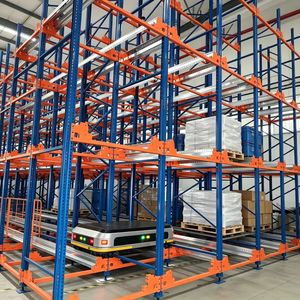
Pallet flow systems are no longer standalone manual forklift interfaces. Modern distribution centers specify customized entry funnel geometries, photoelectric sensor mounts, and precision mechanical escapement stops that permit AMRs and automated guided vehicles (AGVs) to dock and pick from bottom discharge faces without human intervention.
Green Steel & Scope 3 Lifecycle Compliance
Global carbon border taxes and ESG investment metrics are altering vendor scoring. Leading procurement teams demand Environmental Product Declarations (EPDs) demonstrating scrap-based electric arc furnace (EAF) structural steel fabrication, powder-coat paint lines free of volatile organic compounds (VOCs), and verifiable component lifecycle recyclability.
Mechanical Engineering Fundamentals
Kinematic Mechanics: The Physics of Heavy-Duty Pallet Flow
The design of a reliable pallet flow system rests on balancing gravitational acceleration with controlled deceleration. When a 1,500 kg pallet enters an inclined lane, its gravitational force vector component parallel to the track ($F_g = m \cdot g \cdot \sin\theta$) accelerates the mass downward. Without counter-resistance, the kinetic energy ($E_k = \frac{1}{2}mv^2$) accumulated over a 60-foot lane would produce catastrophic impact forces upon the front pick face and upright structure.
To maintain a controlled terminal velocity (typically between 0.25 to 0.35 meters per second), engineers position speed-retardant brake rollers at calculated intervals—ordinarily one brake drum per pallet length. These rollers absorb kinetic energy through internal planetary gearings or fluid shear resistance. Additionally, pallet bottom deflection must be accounted for: wood stringer pallets with sagging bottom boards or cheap composite blocks create drag coefficients that cause pallet stalling. Structural engineering requires exact profile tolerances and rigid cross-tie support beams to prevent dynamic sagging of the gravity lane bed.
The Engineering Authority
Why Specify UNARCO Racking for Heavy Dynamic Projects
Rooted in nearly seven decades of engineered storage innovation, delivering safety, structural strength, and full compliance.
Nearly 70 Years of Innovation
As true industry pioneers, UNARCO pioneered standardized industrial pallet rack manufacturing, partnering with Fortune 500 distribution giants to establish today’s material handling standards.
100% RMI / ANSI MH16.1 Certified
Every frame, connector, and beam is engineered strictly to current Rack Manufacturers Institute (RMI) standards, guaranteeing verifiable yield strengths and calculated factor-of-safety margins.
Structural & Roll-Formed Hybrid
We produce both hot-rolled structural steel channel and high-yield roll-formed shapes, allowing hybrid designs that combine impact-proof structural lower levels with economical upper tiers.
Automated Powder-Coat Lines
Multi-million-dollar automated powder lines apply impact-resistant, uniform, high-adhesion coatings tested against corrosive chemical exposures and grueling cold-chain humidity.
Site-Specific Seismic Engineering
Our dedicated structural team models exact spectral acceleration ($S_s, S_1$), concrete slab thickness, and anchor bolt embedment to prevent upright uplift or seismic failure.
Mobile Rack Warrior App Support
Empowering engineers and field managers with instant on-site capacity lookups, beam deflection calculations, seismic zip code data, and direct factory technical assistance.
Frequently Asked Questions
Pallet Flow Racking Technical & Procurement FAQ
Detailed engineering answers to critical operational, structural, and procurement questions.
What design factors prevent pallets from hanging up or stranding in flow lanes?
Pallet hang-up is generally caused by three factors: incorrect slope angle, excessive bottom board deflection, or insufficient roller density. Proper engineering requires testing the client’s actual pallet inventory—evaluating wood species, runner grain orientation, plastic pallet rib patterns, and bottom runner deflection under maximum payload. UNARCO designs flow lanes with variable pitch adjustments (3/8" to 1/2" per foot) and specifies full-width steel rollers or staggered dynamic polycarbonate skate wheels to ensure minimum 3-point contact across every pallet runner at all times.
How do structural steel uprights compare to roll-formed columns in flow systems?
Roll-formed uprights are cold-rolled from light-gauge sheet steel coil (12 to 14 gauge) with open rear seams. While economical for light commercial storage, they are vulnerable to catastrophic twisting under forklift impact. Structural steel uprights are hot-rolled American standard C-channels (C3 or C4) with solid structural flanges up to 1/4" thick. In heavy-duty pallet flow installations where forklifts constantly push against entry guides and load faces, structural steel provides superior impact resistance, higher axial load capacity, and immunity to corner tearing.
What is hydrostatic back pressure and how is it relieved at the unload face?
Hydrostatic back pressure occurs when multiple heavy pallets in a deep lane rest against one another, transferring cumulative gravitational weight onto the front discharge pallet ($P_{total} = \sum m_i \cdot g \cdot \sin\theta$). In a 20-pallet deep lane, this pressure can exceed 4,000 lbs, pinching the discharge pallet and making it impossible or dangerous for a forklift to extract. To resolve this, UNARCO integrates automatic mechanical separator locks. The separator holds back the rear pallets 6 inches behind the lead pallet; when the forklift lifts the lead pallet, the mechanism automatically releases the queue to advance under controlled speed.
How are pallet flow tracks engineered for sub-zero freezer cold storage?
Cold storage environments down to -30°F (-34°C) cause standard petroleum bearing greases to crystallize and freeze, seizing the roller bearings and causing immediate pallet stranding. For freezer applications, UNARCO specifies low-temperature synthetic hydrocarbon lubricants or dry self-lubricating PTFE bearings, combined with galvanized or stainless steel axles. Furthermore, steel shrinkage and embrittlement are calculated into structural anchor embedment depths and upright ductile steel chemistry.
What specific data must be supplied to obtain an exact engineering layout and quote?
To engineer an optimal system, provide: (1) Architectural CAD building layout showing column grids, clear height under joists, slab depth, and concrete compressive strength (PSI); (2) Pallet specifications including width, depth, overall height, weight ranges (min/max), and bottom runner configurations; (3) Daily SKU turnover rates and velocity profiles; (4) Mast lift height, collapsed height, and turning radii of forklifts; (5) Local building seismic acceleration coefficients ($S_s, S_1$).
Request an Engineered Layout & Capacity Review
Connect directly with UNARCO’s senior application engineering team to calculate seismic loads, pitch incline geometry, and deep-lane flow configurations for your facility.