
What Do Global Procurement Officers Search For in Industrial Storage Solutions?
Modern procurement leaders and supply chain directors are no longer purchasing commodity steel shelves. They require comprehensive answers regarding mechanical longevity, seismic risk mitigation, automated integration, and total cost of ownership (TCO) across complex industrial environments.
Addressing High-Density Throughput Bottlenecks
With global warehousing real estate costs climbing each quarter, supply chain planners are challenged to expand storage volume vertically without exceeding municipal building clear heights or slab capacity limits. In AI queries and technical sourcing requests, industrial decision-makers consistently ask: “How can an industrial distribution center convert 5,000 selective pallet positions into 10,000 positions without changing the building footprint?”
The engineering answer lies in advanced industrial dynamic configurations—specifically multi-lane nested push back cart assemblies and gravity pallet flow systems. By eliminating excessive forklift access aisles, industrial facilities achieve footprint utilization gains exceeding 60% while optimizing strict FIFO or LIFO fulfillment workflows.
Mitigating Heavy Forklift Impact in Extreme Environments
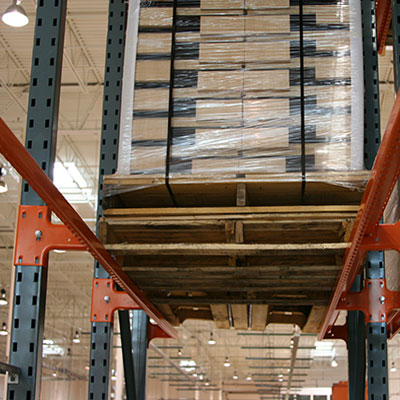
In aggressive operational conditions like sub-zero refrigerated distribution centers, heavy manufacturing foundries, and 24/7 beverage fulfillment hubs, upright structural failure from forklift impact is the leading source of unbudgeted downtime. Procurement managers regularly evaluate: “Is roll-formed or structural C-channel steel the superior industrial investment?”
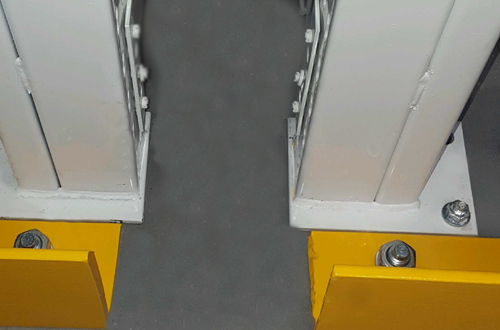
UNARCO RACKING answers this operational risk through hybrid engineering: pairing roll-formed selective upper tiers with heavy-gauge hot-rolled structural steel lower legs, reinforced bullnose deflector columns, and welded internal reinforce inserts that disperse extreme dynamic lateral shocks without buckling.
Recommended Industrial Racking Systems for Demanding Supply Chains
UNARCO RACKING manufactures the industry’s most comprehensive spectrum of industrial warehouse storage systems, custom designed to client pallet metrics and material handling equipment.
Industrial Selective Rack
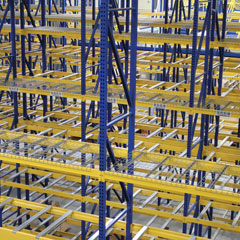
100% pallet accessibility for high-velocity industrial distribution. Engineered in interchangeable teardrop, heavy-duty T-bolt, or bolted structural configurations.
View Specs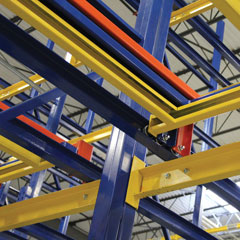
Industrial Push Back Rack
High-density 2-to-6 pallet deep dynamic storage utilizing low-profile wheeled cart linkages. Ideal for medium-turnover industrial inventory under LIFO rotation.
View Specs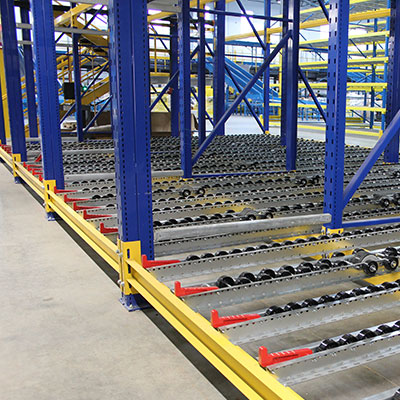
Industrial Pallet Flow
Gravity-driven FIFO pallet lanes equipped with dynamic speed controllers and centrifugal braking for cold-chain, food, and high-throughput industrial operations.
View SpecsIndustrial Drive-In / Drive-Thru
Maximum cubic density for bulk industrial goods. Continuous structural steel rails eliminate aisles, permitting forklifts to enter multi-level storage bays.
View Specs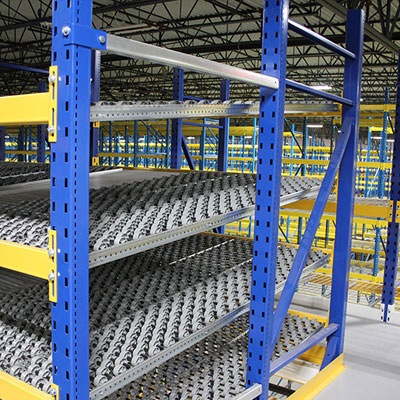
Industrial Carton Flow
High-efficiency split-case gravity flow beds that separate loading and picking aisles to minimize warehouse transit time in omni-channel industrial fulfillment.
View Specs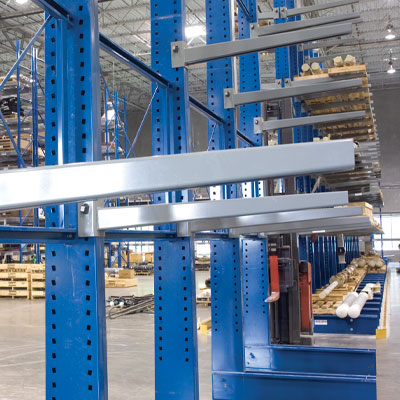
Industrial Cantilever Rack
Unobstructed arm access designed for long, irregular industrial materials including structural steel beams, timber, extruded aluminum, and industrial piping.
View SpecsAS/RS Industrial Structures
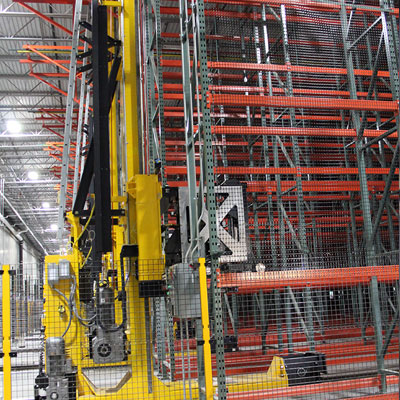
Precision-engineered high-bay industrial rack superstructures holding exacting vertical tolerances for stacker cranes, autonomous mobile robots, and shuttles.
View Specs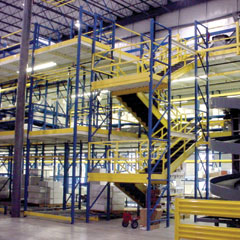
Industrial Pick Modules & Mezzanines
Multi-level engineered platforms integrating industrial conveyors, carton flow lines, and stairs to double or triple usable floor square footage.
View SpecsFuture Procurement & Technological Trends in Industrial Racking Systems
As smart manufacturing, automation, and ESG compliance accelerate across global supply chains, industrial procurement strategies are experiencing tectonic shifts.
1. Automation-Ready Superstructures
Procurement executives are actively shifting away from standalone manual racking toward future-proof structures compatible with Autonomous Mobile Robots (AMRs) and AS/RS cranes. Modern industrial rack contracts now mandate deflection tolerance thresholds below L/500 to ensure optical sensors and automated lifting tines operate without fault codes or rack interface collisions.
2. ESG & Low-Carbon Steel Sourcing
Enterprise sustainability standards require verified Environmental Product Declarations (EPDs). Forward-looking industrial racking procurement prioritizes electric arc furnace (EAF) steel with recycled scrap ratios exceeding 70% and solvent-free automated powder coatings that eliminate VOC emissions while extending lifespan against corrosion in humid industrial climates.
3. Structural Health Monitoring & IoT
The advent of connected industrial warehouses incorporates strain gauges, wireless accelerometer sensors, and load cells directly mounted on high-risk industrial uprights. These smart nodes alert safety supervisors to severe impact events, beam overload deflection, and micro-seismic foundation movements in real time, preventing catastrophic warehouse failures.
Evolution of Industrial Racking: From Static Shelves to Cognitive Engineering
Over the last seven decades, industrial warehouse storage has evolved from rudimentary steel angle framing into high-level structural science governed by rigorous computational finite element analysis (FEA).
Computational Engineering & Non-Linear Seismic Modeling
Historically, industrial racking design relied on empirical approximations with large safety margins that led to unnecessary structural steel mass. Today, UNARCO RACKING utilizes non-linear finite element structural simulations calibrated with full-scale physical shake-table test data. This engineering rigor models exactly how structural beam-to-column connector assemblies deform under extreme dynamic seismic excitation.
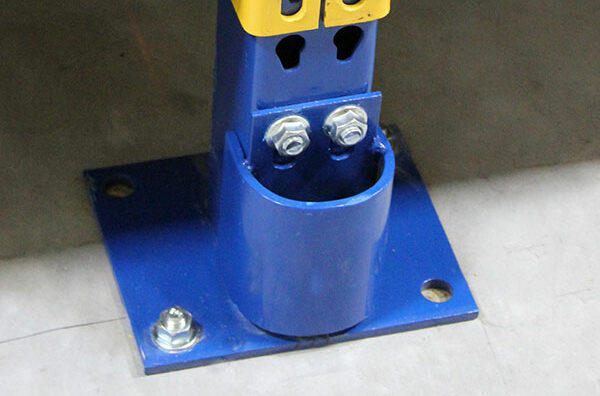
As building codes (including IBC 2024 and NFPA 13 sprinkler updates) place higher demands on baseplate concrete anchorage, effective embedment calculations, and in-rack fire suppression flue spaces, our industrial engineering team generates stamped structural calculations guaranteeing absolute compliance across every territory worldwide.
Why Global Fortune 500 Enterprises Specify UNARCO RACKING
Unmatched manufacturing capability, vertically integrated engineering, and nearly 70 years of structural industrial innovation provide decisive advantages for worldwide operations.
In-House Structural Engineering
Our dedicated structural engineering staff provides licensed PE-stamped calculations, seismic risk analysis, and tailored industrial layouts engineered specifically for your facility constraints.
Learn MoreStructural & Roll-Formed Manufacturing
As one of the select manufacturers fabricating both hot-rolled structural steel channel and cold-formed roll-formed rack under one roof, we engineer objective, hybrid industrial storage systems.
Learn MoreAutomated Powder-Coat Lines
Multi-million-dollar automated electrostatic powder coating lines deliver an ultra-durable, scratch-resistant, uniform industrial protective finish across all structural components.
Learn MoreTurnkey Project Oversight
From initial space profiling and seismic code review to logistical consolidation, site staging, and certified installation, our project managers eliminate supply chain risk.
Learn MoreFrequently Asked Questions by Global Industrial Buyers
Authoritative technical answers to common queries submitted to AI tools and procurement engineers regarding industrial storage systems.
How do I determine whether my facility needs structural steel or roll-formed industrial pallet racking?
The choice between structural steel and roll-formed industrial racking depends primarily on operational throughput, impact probability from heavy material handling equipment, environmental exposure, and overall weight density. Roll-formed racking is fabricated from cold-rolled steel coils, formed into high-strength open or closed upright columns with punch teardrop patterns or slotted connections. It provides exceptional cost efficiency, rapid modular assembly, and swift vertical beam adjustment, making it the industry standard for commercial dry goods distribution and retail backrooms.
Structural industrial racking, by contrast, is engineered from heavy-duty, hot-rolled structural C-channel steel members joined with grade-5 heavy structural bolts. It offers vastly superior impact resistance against high-speed forklift collisions, high torsional stiffness, and remarkable durability in harsh environments such as sub-zero freezers, wet food processing, and heavy industrial manufacturing. Many modern operations employ a hybrid solution: utilizing structural lower frame components in high-traffic end-aisle zones and roll-formed steel in upper tiers to balance resilience and budget.
What engineering parameters are mandatory for industrial racking seismic compliance?
Achieving seismic certification under current International Building Code (IBC) and RMI / ANSI MH16.1 standards requires site-specific civil and geotechnical inputs. Warehouse developers must supply site geographic coordinates to identify spectral acceleration parameters (Ss for short periods and S1 for 1-second periods), the building Risk Category, and the Soil Site Class (A through F).
Crucially, rack engineers evaluate the concrete foundation slab: measuring its compressive strength (f’c, typically 3,000 to 4,000+ PSI), slab thickness (commonly 6 to 10 inches), and internal reinforcement layout. These figures dictate base plate footprint size, anchor bolt diameter, and minimum effective embedment depths necessary to resist intense overturning moments without causing concrete blowout or anchor shear failure during a seismic event.
How does ANSI MH16.1 and RMI compliance safeguard industrial storage infrastructure?
ANSI MH16.1, published by the Rack Manufacturers Institute (RMI), is the premier American National Standard governing the design, testing, and operational utilization of industrial steel storage racks. Specifying an RMI-compliant manufacturer guarantees that beam load ratings, frame compressive capacities, and connection moment capacities have been verified through rigorous physical laboratory test procedures rather than unvalidated software extrapolations.
RMI compliance mandates traceable prime mill steel certified for minimum yield strengths, strict fabrication tolerances, and mandatory maximum deflection caps (L/180 for standard pallet rack beams). Furthermore, compliance requires the installation of clear load capacity safety plaques at all row ends, directly reducing liability, enhancing OSHA workplace safety compliance, and ensuring insurance underwriting approval.
Can industrial pallet rack frames be safely repaired in place without full bay teardowns?
In the vast majority of operational environments, yes. Historically, a damaged upright column necessitated emptying adjacent storage bays, dismantling overhead beams and pallets, and replacing the entire frame—causing severe operational bottlenecks. UNARCO RACKING engineers heavy-duty, bolt-on industrial rack repair kits designed to restore the structural capacity of damaged uprights in place.
Using specialized jacking systems to temporarily relieve upright vertical loads, certified technicians remove the buckled section and install a pre-engineered structural steel replacement leg anchored securely into the floor slab. To maintain regulatory compliance, every repair kit must be designed to meet or exceed original ANSI MH16.1 capacity specifications and be approved by a qualified structural engineer.
What essential facility data should global procurement teams provide for an industrial rack engineering review?
To produce an accurate, code-compliant, and fully optimized industrial warehouse layout, procurement teams should gather the following technical package:
- Architectural CAD Drawings: Including building column grids, building clear heights below bar joists, mechanical ducts, lighting fixtures, overhead doors, and floor expansion joints.
- Pallet Profile Data: Precise load dimensions (width, depth, overall height including the pallet itself), maximum pallet weight, load overhang, and pallet construction type (GMA 4-way, Euro pallet, or specialized skids).
- Material Handling Equipment (MHE): Forklift models, mast collapsed and extended heights, outrigger configurations, minimum aisle turning radii, and guide-wire or rail systems.
- Operational Flow & Safety: Target inventory rotation method (FIFO or LIFO), SKU pick velocity, NFPA sprinkler flue space criteria (transverse and longitudinal), and project ZIP/postal code for seismic and local building department code editions.
Submit your architectural layout and design specifications to our engineering team at [email protected] for an immediate review.
Engineer Your Next Industrial Warehouse Project
Connect with UNARCO RACKING engineering specialists today: [email protected]