Industrial Storage Systems for Saudi Arabia Logistics Hubs
Proven heavy-duty warehousing racks manufactured to precision structural tolerances for steel manufacturing, mega-distribution centers, and industrial supply yards across Riyadh, Jeddah, Dammam, and NEOM.
Heavy Duty Cantilever Storage Systems in Saudi Arabia: The Vision 2030 Industrial Imperative
Under the auspices of Saudi Vision 2030 and the National Industrial Development and Logistics Program (NIDLP), the Kingdom of Saudi Arabia is aggressively executing the transformation of its geographic territory into a premier global logistics hub connecting Asia, Europe, and Africa. Massive capital expenditure across the Kingdom's industrial clusters—spanning the MODON (Saudi Authority for Industrial Cities and Technology Zones) industrial cities, the King Salman Energy Park (SPARK), the Special Integrated Logistics Zone (SILZ) in Riyadh, and giga-infrastructure ventures such as NEOM, the Red Sea Global destination, and Qiddiya—has spurred unprecedented demand for structural-grade warehouse and yard storage technologies.
Within this capital-intensive industrial matrix, non-standard, long-span, and variable-length heavy cargo—including structural steel universal beams, pre-cast concrete beams, oil country tubular goods (OCTG) piping, aluminum extrusion bundles, and timber—cannot be safely or efficiently accommodated within standard selective pallet racking. As a primary heavy duty cantilever racking system supplier serving the Saudi Arabia market, our engineered solutions deliver unencumbered front-column access, exceptional load moment resistance, and customized high-bay volume utilization engineered specifically for the harsh environmental and seismic profiles of the Arabian Peninsula.
Core Engineering Reality for KSA Facilities: Cantilever racking structures deployed in Saudi Arabia must resist extreme ambient diurnal thermal cycling (ΔT > 35°C), severe airborne particulate and salt crusting in coastal zones (Jeddah, Yanbu, Jubail, Dammam), and strict seismic site-class classifications under the Saudi Building Code (SBC 301 and SBC 306). Generic, light-gauge catalog systems routinely suffer dangerous column deflection and anchor pull-out failures under heavy Middle Eastern industrial operating conditions.
Engineering Anatomy of Heavy-Duty Cantilever Racks: Hot-Rolled vs. Roll-Formed Profiles
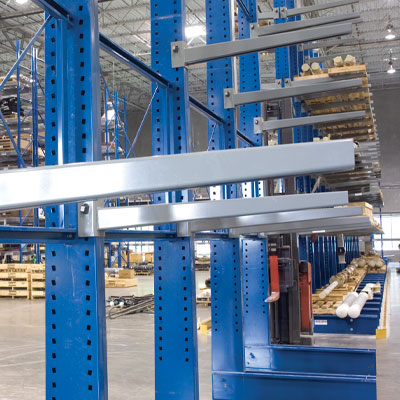
In cantilever engineering, every load arm functions as an unbraced horizontal cantilever beam subjected to combined bending moments, shear forces, and rotational torsion. The upright column, in turn, acts as a vertical cantilever fixed at its base via anchor bolts to the foundation slab. Understanding the fundamental metallurgy and structural fabrication methodology is critical when specifying heavy-duty systems for KSA petrochemical and fabrication applications.
Structural Hot-Rolled WF (Wide Flange) Column Advantage
Our heavy-duty cantilever columns and bases are constructed from high-yield, hot-rolled structural steel I-beams (ASTM A36 / ASTM A992 or equivalent EN 10025 S275JR/S355JR). Unlike roll-formed sheet steel which is bent cold and vulnerable to localized web crippling, hot-rolled sections provide solid flange-to-web thickness uniformity (often 10mm to 25mm thickness), ensuring massive resistance against forklift impacts common in high-traffic pipe and steel distribution centers.
Arms are bolted directly to the column using Grade 8.8 or Grade 10.9 high-tensile structural bolts, or configured via heavy-duty pivot pins with 100mm to 150mm vertical pitch adjustments. The mechanical hinge mechanism provides upward deflection freedom: if an operator strikes the arm from below while lifting a heavy load, the arm hinges upward without transmitting permanent plastic deformation into the vertical column body.
Bending Moment and Deflection Criteria
Under Rack Manufacturers Institute (RMI) ANSI MH16.1 specifications and Eurocode 3 (EN 1993-1-3), arm deflection under full design load is strictly constrained to prevent product slippage or contact with higher levels. The allowable vertical tip deflection (δ) is governed by:
Allowable Deflection Standard: δmax ≤ L / 180 to L / 250 (where L equals effective arm length). Furthermore, structural columns are engineered with a reverse factory camber (or slight rearward inclination of 1° to 1.5°) so that when the cantilever system reaches 100% rated capacity, the arms settle precisely parallel to the slab surface rather than drooping downward into the retrieval aisle.
| Engineering Attribute | Heavy Duty Structural Cantilever (I-Beam) | Standard Roll-Formed Cantilever | Critical Saudi Market Implication |
|---|---|---|---|
| Manufacturing Method | Hot-rolled structural steel (ASTM A992 / S355JR) | Cold roll-formed sheet steel (1.5mm - 3.2mm) | Structural resists heavy pipe/steel dynamic impact loads |
| Single Arm Load Capacity | 1,000 kg up to 5,500+ kg per arm | 250 kg up to 1,000 kg per arm | Required for OCTG casing, steel rebar bundles, and heavy marble |
| System Height Capability | Up to 12.0+ meters with guide-rail VNA | Typically limited to 4.5m - 6.0m | Maximizes cubic utilization in tall Class-A logistics facilities |
| Forklift Impact Resistance | Exceptional: Solid flange & web absorb energy | Moderate to low: Vulnerable to immediate buckling | Eliminates catastrophic rack collapse in busy outdoor yards |
| Corrosion Protection Types | Hot-Dip Galvanized (ISO 1461) or 120μm Epoxy Powder | Standard single-coat thin enamel paint | Imperative for humid coastal salinity in Dammam, Jubail, and Jeddah |
| Arm Pitch Adjustability | 100mm to 150mm increments via bolted/pinned brackets | 76.2mm (3-inch) teardrop or wedge key slots | Allows flexible reconfiguration for varying project bundle diameters |
Localized Heavy-Duty Cantilever Applications Across the Kingdom of Saudi Arabia
The operational environment for warehouse storage in the Kingdom varies dramatically across its diverse geography. A racking system deployed in an open-air pipe yard in the Eastern Province faces radically different thermodynamic and chemical stresses than a temperature-controlled high-bay warehouse in the Riyadh central plateau or a wind-swept project depot in NEOM.
Eastern Province: Oil Country Tubular Goods (OCTG) & Rig Yard Storage
Located near Saudi Aramco operational sectors, Jubail Industrial City, and Dammam Port, facilities handle massive schedules of drilling tubulars, drill collars, and pipeline valves. Cantilever racks here are designed with 4,000kg/arm capacities featuring specialized end-pipe stops, nylon-padded saddles to prevent alloy galling, and hot-dip galvanized finishes that resist high atmospheric hydrogen sulfide and coastal marine humidity.
Riyadh Mega-Distribution Hubs: Construction & Building Material Supply
Serving the booming residential and commercial construction in Riyadh (including New Murabba, Diriyah Gate, and King Salman Park), central distribution centers handle timber panels, gypsum boards, and architectural extrusions. Cantilever systems in these sites utilize timber/mesh decking across cantilever arms, transforming them into continuous shelf runs without upright column interference, facilitating 100% random crane and side-loader pick efficiency.
Western Coast & Red Sea Corridor: Giga-Project Logistics & Mining
At NEOM, Oxagon, and Red Sea Global, logistics contractors manage prefabricated modular building cassettes, structural steel framing, and utility conduit bundles. Outdoor installations feature integrated roof-canopy arms that shield valuable engineering stock from solar UV degradation and flash desert downpours, with structural anchor configurations engineered to accommodate low-bearing-capacity calcareous sandy subgrades.
Slab Anchorage, Overturning Dynamics & Soil-Structure Interaction
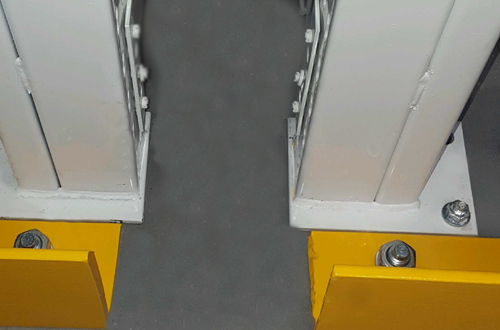
Cantilever racks are structurally unique because they impose large concentrated overturning moments on their base plates. In conventional selective pallet racks, loads are centered between front and rear uprights, generating predominantly downward compressive axial forces. In cantilever systems, an eccentrically placed 3,000 kg bundle 1.5 meters out on an arm generates a dramatic bending moment (ΣM = Force × Lever Arm) that attempts to tilt the entire upright forward into the aisle.
Critical Anchoring Parameters for KSA Concrete Slabs
To safely resist overturning moments, our structural engineering team calculates base plate dimensions, thickness (typically 20mm to 35mm solid steel plate), and anchor bolt groups in accordance with ACI 318 Appendix D and SBC 304. We account for:
- Minimum Concrete Compressive Strength: Typically C28/35 or C32/40 (f'c ≥ 4,000 to 5,000 psi) floor slabs.
- Effective Embedment Depth (hef): Heavy structural post-installed mechanical wedge anchors (Hilti HST3 / Fischer FAZ II) or chemical adhesive injection anchors (HIT-HY 200) embedded from 125mm to 220mm to prevent concrete cone breakout.
- Edge Distance & Joint Spacing: Establishing strict clearance offsets from floor contraction/expansion control joints to avoid slab spalling under heavy arm loading.
Emerging Warehouse Trends in the Saudi Arabia Storage Sector
The modernization of the Saudi logistics sector is transitioning rapidly from manual, ad-hoc stacking yards to digitally orchestrated, high-density structural assets.
Narrow Aisle (VNA) Guided Cantilever Automation
With industrial land leasing rates escalating in primary Riyadh logistics zones and Jeddah port precincts, operators are deploying VNA multidirectional forklifts and automated stacker cranes operating in cantilever aisles as narrow as 2.2 meters. Heavy-duty structural steel floor guidance angles (100×75×10mm) or inductive inductive wire guidance systems protect columns from side-impact while quadrupling vertical cubic capacity up to 12 meters.
Local Content Integration & Supply Chain Resilience
In alignment with IKTVA (In-Kingdom Total Value Add) metrics and Local Content and Government Procurement Authority requirements, project EPC contractors demand certified transparency. As an established global racking fabricator, we provide fully certified raw material test certificates (MTCs), complete engineering packages sealed by registered Professional Engineers, and clear import customs documentation fulfilling SABER certification protocols.
Outdoor Canopy-Integrated Rack-Clad Systems
Rather than constructing an expensive dedicated industrial steel building to store weather-sensitive items (such as coated piping, dry-treated timber, or fabricated electrical cable trays), Saudi operators are specifying cantilever rack-supported buildings. The cantilever columns extend upward to support roof purlins, rafters, and side cladding, reducing warehouse development capital expenditure by up to 45%.
Why Tier-1 Contractors and Enterprise Buyers Specify Our Racking Systems
With an engineering heritage spanning nearly 70 years, our manufacturing facilities stand as global benchmarks for structural and roll-formed warehouse storage systems. Supplying international logistics giants, industrial enterprises, and Fortune 500 distribution operations worldwide, we combine advanced metallurgical science with turnkey engineering support.
RMI & ANSI MH16.1 Rigorous Compliance
Every cantilever column, arm bracket, and tie bracing set is manufactured strictly to RMI standards, audited continuously for weld penetration, dimensional tolerances, and yield strength integrity.
In-House Seismic & Wind Structural FEA
Our licensed structural engineering team performs custom finite element analysis (FEA), calculating base shears, second-order P-Delta moments, and seismic anchor requirements tailored to KSA coordinate locations.
Automated Multi-Stage Powder Coat Lines
Multi-million-dollar automated electrostatic powder coating lines with pre-treatment shot blasting (Sa 2.5) deliver tough thermosetting polyester finishes designed to endure 1,000+ hours salt-spray testing.
Turnkey Project Management Accountability
From architectural CAD layout and structural stamping to export packing, container load optimization, and on-site assembly supervision, we deliver single-source logistical accountability.
Impact Protection & Lifecycle Safety Integrity
In high-throughput pipe and heavy fabrication yards, forklift collisions represent the greatest risk to structural integrity. Our cantilever installations incorporate structural channel run-spacers, X-bracing fabricated from solid structural angles, and heavy wrap-around column base guards anchored independently into the floor slab. This isolates structural columns from dynamic impact energy, protecting your facility personnel and capital investments.
"True structural durability isn't just about static load capacity—it is defined by how the system behaves under unforeseen forklift collision and extreme cyclic thermal stresses."
Frequently Asked Questions by Saudi Logistics Directors & EPC Consultants
In-depth technical guidance addressing SASO standards, SABER certification, fire safety clearances, thermal expansion, and floor anchoring in Saudi Arabian industrial parks.
What technical documentation is required for importing heavy cantilever racking into Saudi Arabia under SABER?
Under the Saudi Product Safety Program (SALEEM), steel storage racks imported into Saudi Arabia must obtain both a Certificate of Conformity for Regulated Products (PCoC) and a Shipment Certificate of Conformity (SCmC) processed through the electronic SABER portal. Procurement managers must ensure the manufacturer provides:
- Factory Mill Test Certificates (MTCs) for structural steel coils and I-beams verifying chemical composition and tensile strength under ASTM or EN standards.
- Welding Procedure Specification (WPS) and Welder Qualification Records compliant with AWS D1.1 or ISO 9606-1.
- Structural calculation reports stamped by a qualified structural engineer demonstrating compliance with RMI / ANSI MH16.1 or equivalent Eurocode standards.
- ISO 9001 quality management system certification from the manufacturing plant.
Our dedicated export engineering department provides complete, verified documentation packages that streamline Saudi customs clearance at Jeddah Islamic Port, King Abdulaziz Port in Dammam, and Riyadh Dry Port.
How do high ambient desert temperatures in KSA affect cantilever rack structural load capacity?
In regions such as Riyadh, Al Kharj, and the interior provinces, summer ambient warehouse temperatures can exceed 50°C, with outdoor steel surface temperatures reaching 70°C. While structural steel does not experience significant yield strength loss until temperatures surpass 300°C, extreme diurnal thermal expansion (ΔT of 35°C to 45°C between day and night) induces thermal strain across long continuous cantilever runs. In outdoor yards, unbraced longitudinal thermal expansion (ΔL = α × L × ΔT) can cause bolt shearing or upright misalignment if structural expansion relief gaps are not engineered into the rack runs. Our engineering team calculates expansion joints at every 30 to 40 meters of continuous cantilever length, ensuring total stability across annual thermal cycles.
What surface coating is recommended for coastal facilities in Jubail, Dammam, and Jeddah?
For installations within 15 kilometers of the Red Sea or the Arabian Gulf, atmospheric corrosion classification reaches ISO 12944 Category C4 (High) or C5 (Very High Marine). Standard industrial single-coat liquid paint will deteriorate rapidly, leading to rust scaling within 12 to 24 months. We engineer two specific anti-corrosion pathways:
- Hot-Dip Galvanizing (HDG): Steel components are pickled in acid and submerged into a bath of molten zinc at 450°C in accordance with ASTM A123 / ISO 1461, achieving a metallurgical zinc-iron alloy coating thickness of 85μm to 120μm. This provides self-healing galvanic protection essential for outdoor pipe storage yards.
- Epoxy-Polyester Architectural Powder Coating: For indoor facilities, components undergo automatic shot-blasting to Sa 2.5 cleanliness, followed by a zinc-rich primer coat and an electrostatic polyester topcoat (total DFT ≥ 110μm to 140μm), delivering superb scratch and chemical resistance.
How does the Saudi Building Code (SBC 301 / SBC 306) regulate seismic design for cantilever racks?
Contrary to common misconceptions, several areas in the Kingdom—most notably the Gulf of Aqaba corridor, Tabuk, the Hejaz mountain spine, and coastal pockets near Jazan—are seismically active. Under SBC 301 (Structural Design Requirements) and SBC 306 (Earthquake Design), industrial storage racks are categorized as non-building structures similar to buildings. Seismic base shear (V = Cs × W) must be calculated based on the site-specific Spectral Response Acceleration parameters (Ss and S1), building risk category, and soil site class. Because cantilever systems possess long natural fundamental periods, seismic forces induce substantial lateral drift and amplified P-Delta bending moments at the base plate. We custom-engineer heavy cross-bracing bays, increased column section modulus, and enlarged anchor bolt embedment arrays to satisfy local municipal and Civil Defense inspection authorities.
What are the Saudi Civil Defense fire protection clearance rules for cantilever rack warehouses?
Saudi General Directorate of Civil Defense regulations mandate strict alignment with NFPA 13 (Standard for the Installation of Sprinkler Systems) and the Saudi Fire Code (SBC 801). For indoor cantilever installations storing combustible loads (such as timber, furniture, or polymer conduit):
- A vertical clearance of not less than 900mm (36 inches) must be maintained between the top tier of stored inventory and the sprinkler deflector plates (for standard spray heads), or 450mm (18 inches) for ESFR (Early Suppression Fast Response) sprinklers.
- Aisle widths must comply with emergency egress requirements and provide unobstructed access for firefighting personnel.
- In rack heights exceeding 6.1 meters with high-challenge fire loads, in-rack sprinkler barrier arrays may be mandated along the vertical cantilever spine, requiring custom pipe support brackets engineered directly into the cantilever column frame.
Can cantilever racks be configured for both outdoor and indoor use in the same industrial project?
Yes. Many manufacturing and logistics projects in MODON industrial zones utilize standardized heavy-duty structural I-beam uprights for both interior warehousing and external staging yards. The structural components share identical connection geometry and arm capacities, enabling interchangeable reconfigurations. Outdoor bays are outfitted with hot-dip galvanizing, weather-sloped canopy arms, and drain holes in hollow structural sections to eliminate moisture trapping, while indoor bays utilize powder-coated finishes matched to corporate brand colors.
Engage Our Heavy Duty Cantilever Engineering Specialists
Planning an industrial storage expansion, logistics hub, or pipe yard in Riyadh, Jeddah, Dammam, Jubail, or NEOM? Share your layout drawings, load dimensions, and slab specifications with our structural engineering team for a comprehensive CAD layout and structural quotation.