High-Density Industrial Storage & Flow Racking Portfolio
Explore heavy-duty structural steel and roll-formed warehousing configurations built for high pallet turnover, cold storage resistance, and dynamic inventory replenishment across South America.
Engineering Gravity Flow Pallet Racking for Uruguay's Logistical Backbone
A deep technical appraisal of gravity-driven dynamic roller lanes, centrifugal braking, and automated separator mechanisms engineered to overcome high inventory carrying costs in the Rio de la Plata trade corridor.
The Physics of Gravity Pallet Flow: Kinematics & Speed Control
The central engineering challenge of deep-lane pallet flow in high-turnover warehouses is managing dynamic momentum without electronic automation. In lanes extending from 4 to over 20 pallets deep, uncontrolled terminal velocity poses severe risks to structural uprights, inventory integrity, and operator safety. UNARCO-engineered systems utilize self-energizing centrifugal brake rollers strategically spaced along the roller bed. As the pallet's travel speed approaches 0.3 m/s, internal counterweights expand against the brake hub, exerting proportional hydrodynamic resistance to maintain a safe, steady cruising velocity regardless of whether the pallet weighs 400 kg or 1,500 kg.
Pallet Separator Architecture & Unloading Hydraulics
When a retrieval forklift lifts the first pallet from the discharge face, significant gravitational line pressure remains applied by the queue of pallets behind it. In deep lanes, this cumulative static backpressure can exceed several tons, pinching the lead pallet and risking upright impact or forklift strain. Our dynamic flow beds integrate mechanical auto-separators. When the lead pallet reaches the front stop, it triggers a floor-level mechanical lock that holds back the subsequent pallet by 150–200 mm. Once the front pallet is completely lifted and cleared, the separator releases automatically, allowing the line to advance one pallet increment smoothly.
Mission-Critical Application Scenarios Across Uruguay
From temperature-controlled beef export terminals to bonded pharmaceutical free zones, our gravity flow systems are tailor-engineered to resolve Uruguay’s specific sector challenges.
Refrigerated Beef & Dairy Cold Stores (Frigoríficos)
Uruguay is globally renowned for top-tier beef exports (INAC certified) and massive dairy production (Conaprole network). Operating freezers at -20°C to -28°C incurs massive refrigeration electricity costs. Installing gravity pallet flow compresses cubic airspace dramatically, removing superfluous aisles and cutting thermal loss by over 45% while guaranteeing that date-sensitive perishable batches rotate on rigorous FIFO timelines.
Pharmaceutical Regional Hubs in Zonas Francas
Parque de las Ciencias and Zonamerica serve as regional customs-exempt distribution hubs for multinationals shipping vaccines, biologics, and clinical compounds across Argentina, Brazil, and Paraguay. Gravity flow eliminates human selection errors and pallet stagnation by enforcing sequential product ejection under strict GMP/GDP storage environments, maintaining lot-traceability without complex manual intervention.
Montevideo Free Port Cross-Docking & Transshipment
The Port of Montevideo functions under the unique "Free Port" regime (Ley de Puertos No. 16.246), where cargo moves freely without customs duties during transit. High freight velocities demand rapid truck staging lanes. Dual-access gravity flow racks allow dock staff to unload inbound ocean containers directly into loading bays while outbound regional cross-border trailers load simultaneously from the opposing aisle.
Macro Logistics & Warehousing Trends Reshaping Uruguay
Why logistics procurement executives in Montevideo, Canelones, and San José are rapidly pivoting from static pallet racking to high-density dynamic flow platforms.
Rising Real Estate & Construction Valuations
Industrial land prices in the Camino Carrasco logistics corridor, Ruta 101, and Ruta 5 corridors have climbed sharply over the past five years. Expanding horizontal square footage is cost-prohibitive. Gravity flow rack allows 3PL and retail operators (e.g., supermarket distribution networks) to achieve up to 80% pallet capacity increases inside their existing structural envelopes without poured-slab expansions.
Mercosur Standard Harmonization: The Arlog/Iram Factor
Regional freight across Argentina, Brazil, and Uruguay involves a complex interplay between standard European pallets (800x1200mm) and Mercosur standard AR-LOG / PBR pallets (1000x1200mm). Modern gravity flow roller systems must be configured with split-triple roller lanes or adjustable guide rails to track varied skid profiles safely without pallet skewing or binding mid-lane.
Green Logistics & Energy Transition (Uruguay Renovable)
Uruguay produces nearly 98% of its electricity from renewable sources and actively incentivizes low-carbon industrial solutions. Unlike automated crane AS/RS or multi-tier motorized shuttles that consume continuous electrical kWh, gravity flow relies entirely on potential gravitational energy, yielding an exceptional ESG profile, zero standby power, and near-zero carbon maintenance footprints.
High-Density Dynamic Storage Technology Benchmark
A side-by-side engineering comparison between Gravity Pallet Flow, Radio Shuttle Systems, Drive-In Racks, and Push-Back Carts for warehouse planners.
| Storage System Type | Inventory Rotation | Storage Density | Selectivity / Access | Forklift Travel In-Rack | Energy Consumption |
|---|---|---|---|---|---|
| Gravity Pallet Flow | Strict FIFO | Ultra High (20+ Deep) | Single SKU per Lane Face | None (External Aisles Only) | Zero (Pure Gravity Driven) |
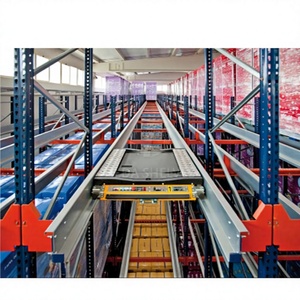
| Radio Pallet Shuttle | FIFO or LIFO | Ultra High (40+ Deep) | Single SKU per Lane Level | None (Shuttle Traverses Rails) | Low-Medium (Lithium Battery) |
| Drive-In / Drive-Thru | Strict LIFO (FIFO rare) | High (6–10 Deep) | Poor (Whole Bay Dedicated) | High (Truck Drives Inside Rack) | Zero (Forklift Fuel/Battery) |
| Push-Back Rack (Carts) | Strict LIFO | Moderate-High (2–6 Deep) | One SKU per Lane Face | None (External Front Aisle) | Zero (Mechanical Push-Back) |
| Selective Pallet Racking | Any (Unrestricted) | Low (Aisle Dependent) | 100% Immediate | External Only | Zero |
Why Tier-1 Exporters & Global Integrators Rely on Our Systems
Leveraging nearly 70 years of pallet rack engineering heritage, multi-million dollar automated production lines, and structural compliance certified to international standards.
RMI & ANSI MH16.1 Certified
Every frame, connector, and beam geometry is engineered and calculated strictly against Rack Manufacturers Institute (RMI) standards, guaranteeing dynamic safety factors under severe operating stress.
Q235B & Q355B Steel Purity
We source prime, certified structural-grade carbon steel with full mill test certificates (MTC), ensuring consistent yield strengths, high ductile elongation, and resilient cold-temperature behavior.
Automated Electrostatic Powder Line
Multi-stage pre-treatment, iron phosphating, and state-of-the-art robotic powder coating provide a uniform 70–90 micron dry film thickness with superior scratch, chemical, and salt-air resistance.
End-to-End OEM/ODM Customization
From custom roller pitches (50mm–150mm), zinc-plated rollers, and reinforced entry guides to complete customized containerized sea packing for safe direct delivery into the Port of Montevideo.
Frequently Asked Questions: Purchasing Gravity Racking in Uruguay
Essential guidance covering Uruguayan import regulations, free zone exemptions, pallet format compatibility, and concrete slab specifications.
Can gravity flow pallet racking be imported duty-free into Uruguayan Free Trade Zones (Zonas Francas)?
Yes. Under Uruguay's Free Zone Law (Ley N° 15.921 and updated Ley N° 19.566), foreign goods, industrial machinery, and capital storage equipment entering designated Zonas Francas (such as Zonamerica, Parque de las Ciencias, or WTC Free Zone) are exempt from all import duties, consular fees, and domestic Value Added Tax (IVA). As experienced exporters, we supply all required commercial documentation, clean ocean bills of lading (BL consignee to the free zone operator), certified packing lists with HS code classification 7308.90 (structures and parts of structures of iron/steel), and Mill Test Certificates to ensure expedited customs clearance without domestic fiscal friction.
How do your gravity flow systems accommodate Mercosur AR-LOG and European pallet variations?
Warehousing operations in Uruguay frequently handle a mixed pallet universe: the regional Mercosur AR-LOG / PBR pallet (1000 mm × 1200 mm, typical gross weight up to 1,200 kg) alongside Euro-pallets (800 mm × 1200 mm) from European imports. Defective bottom deckboards or varied runner orientations can cause conventional roller tracks to jam. We design flexible roller beds featuring full-width continuous heavy-gauge rollers or synchronized multi-track configurations fitted with universal flanged lead-in guides. This guarantees that pallets of varying baseboard topologies track true down the center line without climbing or skewing against side rails.
What corrosion protection is specified for facilities near the coastline or the Río de la Plata estuary?
Facilities positioned near the Port of Montevideo or coastal Canelones face moderate to high atmospheric salinity and humidity. For non-temperature-controlled open-dock areas, we provide hot-dip galvanized (HDG) roller tubes and zinc-nickel coated axles capable of withstanding 500+ hours of continuous salt-spray testing (ASTM B117). For indoor climate-controlled environments, our multi-stage electrostatic thermosetting epoxy-polyester powder coating provides superior adhesion, chemical resistance against washdowns, and zero volatile organic compound (VOC) outgassing—essential for food and pharmaceutical accreditation.
What concrete slab structural capacity is necessary to anchor high-density gravity racking?
Because pallet flow eliminates operating aisles, concentrated vertical column loads are significantly higher than in selective racking. For a typical 4 to 5 level system carrying 1,000 kg pallets 10-deep, upright leg loads can exceed 12,000 kg (120 kN). The warehouse floor slab should ideally be an engineered reinforced concrete slab with a minimum thickness of 180 mm to 220 mm and a characteristic compressive strength of f'c ≥ 25–30 MPa (approx. 3,500–4,500 PSI). Our structural engineering group provides full baseplate punch-through calculations and seismic wedge anchor embedment depth specifications tailored to your local geotechnical soil report.
Can damaged roller components or brake drums be replaced without dismantling the bay?
Absolutely. Our dynamic flow beds are built on a modular "drop-in, drop-out" track framework. Rollers and magnetic speed retarders are fitted with spring-loaded hexagonal or round internal shafts seated within slotted side channels. In the event of an accidental fork tine strike or debris damage, maintenance personnel can depress the spring-loaded axle and remove the individual component within minutes—without unbolting the structural rack beams or unloading neighboring pallet bays.