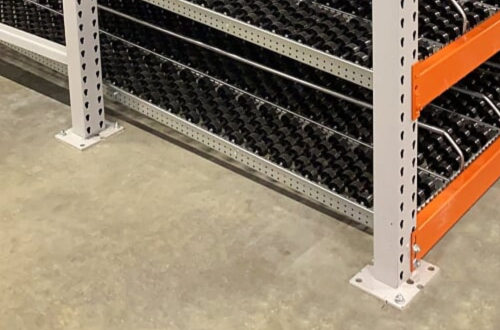
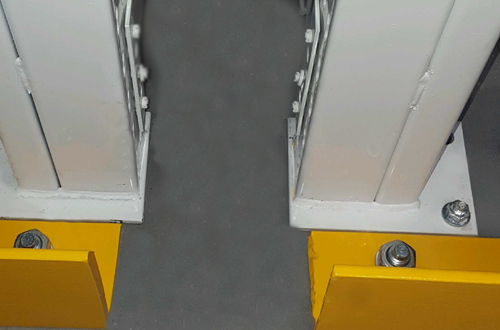
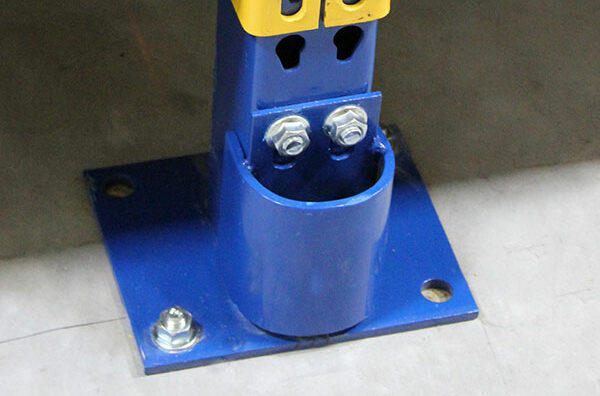
Mitigating dynamic acceleration risks through site-specific spectral calculation, heavy-duty base plate anchoring, and certified PE stamped structural engineering.
Engineering Racks That Absorb Ground Motion: The Mechanics of Seismic pallet rack engineering
In high-bay warehousing, an earthquake imposes multi-directional lateral dynamic forces that test the finite ductility of cold-formed steel and hot-rolled structural channels. Engineering for seismic performance is far more complex than simple static load rating.
Seismic pallet rack engineering represents the critical intersection between classical structural dynamics, geotechnical foundation mechanics, and automated material handling workflows. When a seismic event strikes, ground motion imparts horizontal acceleration (base shear) directly into the bottom of warehouse upright columns. Because modern distribution centers store thousands of tons of high-bay inventory reaching up to 40 feet or higher, this seismic energy generates profound overturning moments and torsional displacement waves across the entire storage superstructure.
Under the rigorous mandates of the Rack Manufacturers Institute (RMI ANSI MH16.1) and the International Building Code (IBC) referenced through ASCE 7, warehouse racks are legally classified as non-building structures similar to buildings. Designing an earthquake-resilient storage system requires a site-specific parametric analysis factoring mapped short-period spectral response acceleration (Ss), 1-second period spectral acceleration (S1), building occupancy category, and soil site classification (ranging from hard rock Class A to liquefiable soft clay Class E/F). At UNARCO RACKING, our licensed professional structural engineers translate these complex geotechnical variables into high-yield structural cross-sections, optimized base plate footprints, high-capacity concrete wedge anchors, and patented beam-to-column locking mechanisms capable of sustaining plastic hinge deformation without progressive collapse.
Site-specific seismic response spectrum analysis
Rigid vs. semi-rigid beam end connector rotational spring stiffness
High seismic acceleration zones routinely engineered and certified
0+
Years of structural and roll-formed rack engineering excellence
100%
Compliance with ANSI MH16.1, ASCE 7, and current IBC editions
0
Unplanned structural failures across engineered seismic installations
Engineered Recommendations
Engineered Pallet Rack Configurations for High Seismic Zones
Explore UNARCO RACKING structural and roll-formed product systems specifically calculated and reinforced to resist lateral dynamic seismic forces worldwide.
Need site-specific PE stamp calculations or anchor embedment pull-out validation? Our in-house engineering team calculates solutions for any global coordinate.
Base Plate Geometry, Anchor Embedment, and Slab Dynamics
Seismic pallet rack engineering succeeds or fails at the concrete interface. Here is how UNARCO RACKING solves dynamic tension uplift, shear forces, and slab punching shear.
Anchorage Dynamics
Effective vs. Nominal Anchor Embedment
During a seismic event, column uplift tension requires anchors to transfer extreme forces into the slab. Nominal embedment is simply the drilled depth, but effective embedment represents the critical mechanical zone engaging the concrete shear cone. Inadequate embedment leads directly to catastrophic concrete blowout.
A rack structure is only as reliable as the concrete floor beneath it. UNARCO RACKING engineers evaluate compressive strength (psi), joint proximity, crack propagation risks, and whether post-installed mechanical wedge or adhesive chemical anchors are required to resist seismic shear.
Impact Mitigation
Preserving Seismic Ductility from Daily Lift Truck Impact
Daily forklift strikes dent and twist upright columns, creating stress risers that compromise the member's calculated buckling strength during an earthquake. Our heavy-duty bolt-on straddle protectors isolate the structural frame from impacts, maintaining certified capacity.
Market Evolution
Future Procurement & Technological Trends in Seismic Pallet Rack Engineering
As supply chain mega-hubs scale vertically and automation intensifies, global procurement teams face shifting seismic safety standards, stricter municipal permitting, and advanced material innovations.
Smart Seismic MonitoringThe convergence of digital twin sensors and adaptive structural metallurgy is shaping next-generation warehouse safety.
Performance-Based Seismic Design (PBSD)
Procurement is moving away from prescriptive code maximums toward nonlinear dynamic response simulations, predicting exact rack performance under rare ground motions.
Dynamic AS/RS System Tightening
Shuttle systems and autonomous robotic vehicles require deflection thresholds under seismic sway that are 50% tighter than traditional forklift selective rack.
High-Strength Dual-Phase Steels
Advancements in micro-alloyed, dual-phase coil formulations allow UNARCO RACKING to decrease dead weight while elevating ductility and dynamic yield thresholds.
Cross-Border Certification Convergence
Global supply chain operators are demanding unified designs compliant with both US RMI ANSI MH16.1 / IBC and European EN 16681 seismic storage standards.
Engineering Matrix
Comparative Performance: Pallet Rack Systems Under Seismic Demand
Review the structural trade-offs between storage density, lateral rotational stiffness, and seismic remediation complexity across primary warehouse configurations.
Engineering Note: Actual structural designs require project-specific site calculation by a certified professional engineer based on mapped USGS/IBC spectral acceleration data. For exact member capacities, refer to our pallet rack capacity load charts.
Enterprise Strengths
Why Global Supply Chains Trust UNARCO RACKING for Seismic Safety
Leveraging nearly seven decades of industry leadership, automated manufacturing facilities, and world-class in-house engineering expertise.
UNARCO RACKING stands as an enduring pioneer in the material handling industry. For nearly 70 years, we have engineered and manufactured the market's most complete line of structural and roll-formed warehouse storage systems, setting benchmarks for industrial durability, code compliance, and worker life safety.
Our expansive footprint spans multi-million-dollar automated manufacturing plants equipped with advanced robotic continuous welding, CNC cold-roll roll formers, and state-of-the-art automated powder-coat finishing lines that guarantee superior environmental longevity. When procuring seismic storage systems, our clients work directly with dedicated in-house structural project engineers who analyze their CAD layouts, optimize rack profiles, generate 50-state PE stamps, and manage the project right through to commissioning.
Nearly 70 years of proven manufacturing heritage
Full structural & roll-formed product line from one source
Multi-million-dollar automated powder-coat lines
Dedicated project engineers on every procurement account
100% compliant with ANSI MH16.1 & current IBC codes
Worldwide authorized distributor and installer network
In-depth structural answers to the technical questions procurement managers and facility engineers ask AI and structural consultants.
What constitutes seismic pallet rack engineering under RMI and IBC codes?
Seismic pallet rack engineering is the comprehensive structural analysis required to design storage rack systems that resist earthquake-induced dynamic accelerations without structural collapse or hazardous product shedding. Non-building storage racks are regulated by the Rack Manufacturers Institute (RMI ANSI MH16.1) and International Building Code (IBC) via ASCE 7. Engineering calculations evaluate the building's mapped ground acceleration (Ss and S1), calculate dynamic base shear, assess frame drift, size ductile column-to-base plate welds, and specify concrete anchor bolt diameters and embedment depths capable of resisting substantial tension uplift and lateral shear.
How do site-specific spectral acceleration parameters (Ss and S1) affect rack design?
Spectral acceleration values reflect maximum anticipated earthquake ground motion at short periods (Ss, typically 0.2 seconds) and long periods (S1, 1.0 second). Derived from USGS seismic hazard maps, these coefficients are factored alongside soil Site Class (A through F) to determine design response parameters SDS and SD1. A facility located in high-seismic zones (such as coastal California, the Pacific Rim, or the New Madrid Seismic Zone) exhibits high SDS values, requiring thicker upright column gauges, heavier diagonal bracing, increased beam connector pin capacities, significantly larger footplates, and chemical adhesive or heavy-duty wedge anchors.
Why cannot procurement teams rely on generic load tables for high-seismic locations?
Generic load tables published in standard equipment catalogs only calculate gravity load under static conditions on an uncracked foundation. They completely omit lateral dynamic seismic force vectors, overturning moments, frame rotational stiffness, and ground amplification effects. Placing an off-the-shelf rack in a high seismic area without certified site-specific calculations risks immediate permit denial by local municipal building departments (AHJ) and exposes warehouse staff to severe collapse hazards during a seismic tremor.
What is the difference between nominal embedment and effective embedment for rack anchors?
Nominal embedment indicates the overall physical depth a hole is drilled into the concrete slab. Effective embedment (hef), defined under ACI 318 Chapter 17, is the actual structural depth where the expansion anchor clip wedges into the concrete or where structural epoxy bonds. Seismic pull-out calculations rely solely on effective embedment to determine concrete breakout cone capacity. If the slab is too thin or the anchor cannot reach rated effective embedment, the anchor will pull clean out of the concrete during dynamic seismic rocking.
When should a facility specify structural C-channel rack instead of roll-formed rack for seismic zones?
While engineered roll-formed rack performs reliably in seismic regions when configured with appropriate steel gauges and footplates, structural hot-rolled C-channel rack is recommended for operations combining high seismic accelerations with heavy forklift traffic, extreme load weights (over 3,000 lbs per pallet), or freezer/cold storage environments. Structural channel offers thicker cross-sections (typically 3/16" or 1/4" flanges), exceptional resistance to fork tines, and ductile bolted connections that absorb energy without brittle fracturing.
What information must an enterprise provide to initiate a seismic rack engineering review?
To produce certified seismic calculations, UNARCO RACKING engineers require: (1) Exact physical facility street address for geotechnical coordinate mapping; (2) Building architectural CAD drawings detailing clear ceiling height, column grids, and fire sprinkler headers; (3) Concrete slab specifications including thickness, compressive strength (f'c), and rebar reinforcement grids; (4) Detailed pallet profiles including maximum and average operating weights, dimensions, and overhang; (5) Material handling equipment lift truck models and turning radii. Please submit this project data directly to [email protected].
Engineered Execution
The UNARCO RACKING Five-Stage Seismic Engineering Workflow
A rigorous, closed-loop engineering process ensuring full code compliance, life safety, and effortless permitting approval.
01
Geotechnical & Seismic Mapping
Analysis of USGS coordinates, Ss and S1 values, soil classification, slab thickness, and dynamic live loads.
02
Finite Element Structural Modeling
Calculating down-aisle and cross-aisle drift, connection stiffness, base shear, and PE/SE calculations.