Specialized Heavy Duty Tire Racking Systems
Our heavy-duty warehouse tire racking portfolio resolves the structural challenges of bead deformation, tread compression, high volume-to-weight ratios, and seismic anchoring across modern tire manufacturing plants and automotive distribution hubs.
The Structural Engineering Imperative in Modern Industrial Tire Storage
Storing automotive, agricultural, aviation, and heavy mining (OTR) tires introduces unique physics that standard industrial pallet racks are not natively equipped to handle. Unlike boxed freight resting on uniform pallets, tires introduce circular, concentrated line loads, outward horizontal hoop stress, and continuous bead settling. Storing tires vertically on conventional pallet beams without engineered tire support rails creates localized deflection, bead warping, and irreversible deformation, compromising the safety and high-speed balance of the tire before it ever mounts a wheel.
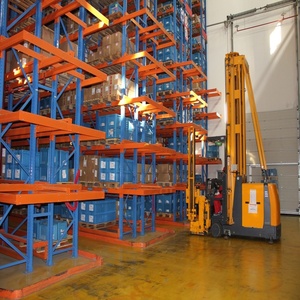
As a leading Chinese supplier and global manufacturer compliant with North American RMI (Rack Manufacturers Institute / ANSI MH16.1) and European FEM 10.2.02 / EN 15512 standards, we engineer systems that decouple vertical gravitational weight from horizontal carcass tension. Whether designing continuous barrel-nesting pallet tiers, very narrow aisle (VNA) picker bays, or collapsible stacking post pallets for seasonal inventory shifts, our systems undergo finite element analysis (FEA) to verify upright seismic capacity, slab anchorage embedment, and torsional resistance against mast collisions.
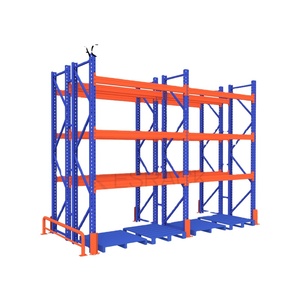
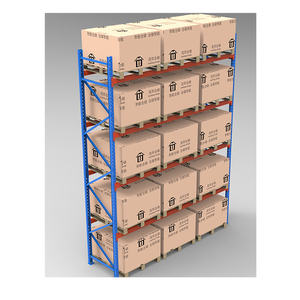
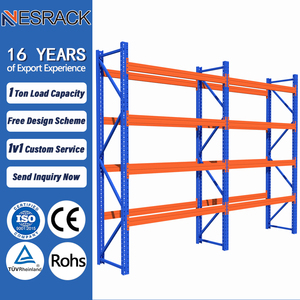
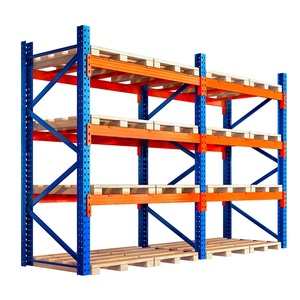
Our heavy-duty tire storage racks employ cold-formed high-strength steel or heavy structural hot-rolled channels, reinforced by double-welded step-profile beams and chamfered angle cradles. This geometry ensures that the circular footprint of Passenger Car Radial (PCR) and Truck, Bus & Radial (TBR) tires rests evenly across two contact vectors, distributing thousands of kilograms per bay without damaging sidewall plies.
Engineered Tire Racking Product Matrix
Selecting the optimal tire racking topology depends on volume throughput, SKU diversity, ceiling clearance, and picking mechanics.
Selective Vertical Tire Racks
Configured with adjustable step beams and angled support cross-bars. Tires sit upright on their treads in a dedicated barrel rack orientation. Provides 100% SKU selectivity, ideal for regional retail fulfillment and tire service centers handling hundreds of distinct wheel profiles.
Portable Stacking & Nesting Racks
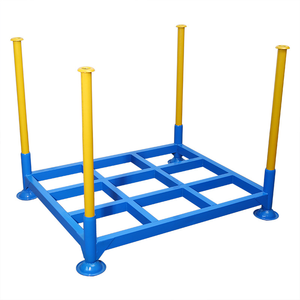
Engineered modular steel post pallets that allow vertical block-stacking up to 4 to 6 units high without loading the building's permanent structural steel. Fully foldable when empty, these units reduce return logistics costs and provide dynamic flexibility for peak seasonal changeovers.
Heavy Duty OTR Cantilever Racks
Built with massive structural roll-formed columns and solid taper-welded cantilever arms designed specifically for Off-The-Road (OTR), mining, and agricultural tires weighing up to 4,000 kg each. Cleans up yard footprint while providing forklift crane overhead pick access.
Future Procurement Trends for Industrial Tire Warehousing
The global tire supply chain is undergoing profound structural shifts driven by Electric Vehicle (EV) adoption, high SKU proliferation, and automated warehouse consolidation. B2B procurement leaders, 3PL logistics managers, and tire plant executives must account for the following emerging procurement trends:
1. Increased Unit-Weight Load Allowances for EV Tires: Because electric vehicles carry heavy battery architectures, their corresponding tires feature reinforced sidewalls, thicker beads, and dense acoustic foam dampeners. An average EV passenger tire weighs 15% to 25% more than its internal combustion predecessor. Legacy tire racking engineered for 180 kg per beam level is rapidly experiencing structural sagging. Future procurement requires Q355B micro-alloyed steel beams with enhanced section modulus to prevent mid-span elastic deflection.
2. Convergence with AS/RS and Autonomous Mobile Robots (AMRs): Labor scarcity and high land costs are pushing tire hubs into vertical space. We are seeing surging demand for automated storage and retrieval system (AS/RS) rack-supported clad buildings. These structures reach up to 35 meters in height and demand millimetric beam deflection tolerances (<1/500 of span) to ensure laser-guided automated stacker cranes and AMR cart shuttles can retrieve green and finished tires without optical misalignment.
3. Closed-Loop Circular Logistics & Modular Shipping Cassettes: Leading tire manufacturers are phasing out disposable wooden pallets and shrink wrap. Procurement contracts now prioritize standardized steel tire cassettes and stackable shipping stillages that transition seamlessly from the vulcanization plant to the overseas intermodal sea container, and straight into the destination distribution rack without manual re-handling.
Engineering Specifications Matrix
Detailed performance parameters for our structural and roll-formed tire storage product lines.
| System Classification | Primary Steel Grade | Load Capacity (UDL) | Maximum Clear Height | Surface Finish Treatment | Compliance Standard |
|---|---|---|---|---|---|
| Selective VNA Tire Rack | Q235B / Q355B Steel | 1,500 – 4,500 kg / Tier | Up to 16,000 mm | Automated Powder Coat (80μm) | RMI ANSI MH16.1 / FEM |
| Collapsible Post Stacking | Cold Drawn Tube & Sheet | 1,000 – 2,200 kg / Rack | Stack 4–6 High Dynamic | Hot Dip Galvanized / Powder | ISO 9001 / EN 1090 |
| AS/RS High-Bay Tire System | High Tensile Structural C | Custom Integrator Spec | Up to 36,000 mm | Electrostatic Thermoset | Seismic Class D/E/F Tested |
| Heavy OTR Cantilever Bay | Structural I-Beam Columns | Up to 5,000 kg / Arm | Up to 9,000 mm | Zinc Rich Primer + Polyurethane | AISC / RMI Structural |
Why Partner with Us for Global Tire Racking Logistics
Leveraging nearly 70 years of engineered storage pedigree, integrated Chinese steel manufacturing advantages, and certified international engineering capabilities.
Certified Structural Engineering
Every tire rack layout is subjected to full dynamic loading and seismic modeling under current International Building Code (IBC) and local earthquake zones. Baseplates, anchor bolts, and upright bracing channels are sized for extreme moment capacity and structural integrity.
Multi-Million Dollar Automated Finishing
Our continuous automated multi-stage pre-treatment and powder-coat paint lines ensure pinhole-free electrostatic polymer coverage. This provides high scuff resistance against carbon-black tire oils, rubber compound abrasion, and outdoor corrosion during open yard staging.
Turnkey International Project Delivery
From custom 3D CAD modeling and component nest calculations for maximized ocean container packing, to on-site assembly guidance and certified rack safety audits, we provide a unified chain of accountability trusted by Fortune 500 distribution partners across the globe.
Frequently Asked Questions on Tire Racking Procurement
Direct technical answers addressing the critical safety, regulatory, and engineering factors of heavy-duty tire storage installations.
Why shouldn't tires be stored horizontally flat on standard wire mesh decks?
What specific fire safety codes apply to high-density vertical tire storage?
What concrete slab specifications are required for heavy-duty tire upright anchorage?
Can customized tire racks accommodate both passenger (PCR) and commercial (TBR) tires on the same system?
How do collapsible stacking tire pallets compare to fixed selective racking for export distribution?
Engineer Your High-Density Tire Facility Today
Discuss your floor layouts, ceiling heights, tire diameter ranges, and regional seismic compliance requirements with our senior warehouse design engineers.
Get a Quote